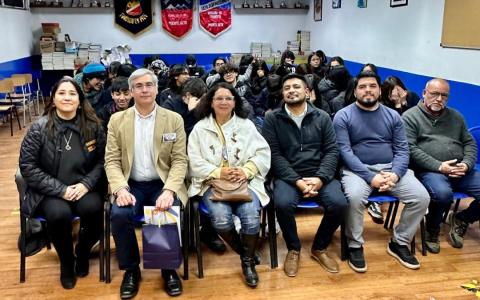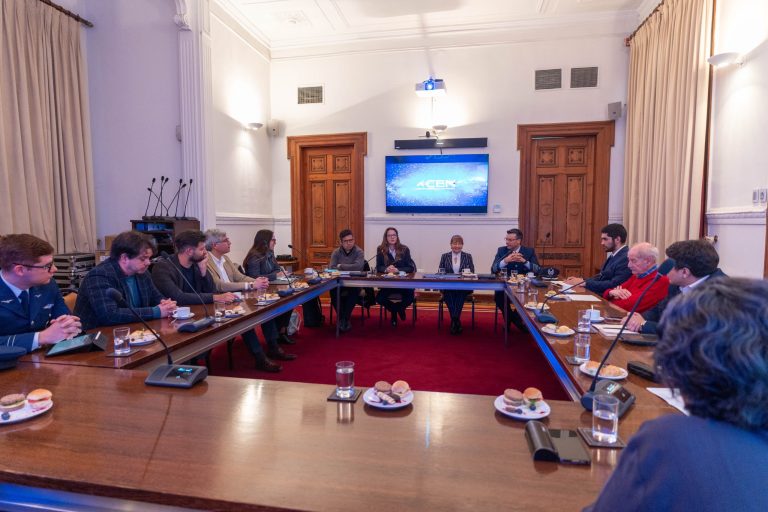



Science teachers from different regions of the country took part in an intensive day of training in nanoscience and nanotechnology on Thursday, October 13, at the largest research center in the field, CEDENNA (Center for the Development of Nanoscience and Nanotechnology), located in the USACH Research Building.
ProNano, now in its 7th edition, is a nanoscience and nanotechnology training program for high school teachers, aimed at supporting them with knowledge and tools that allow them to effectively teach their students, since these contents were incorporated into the Science Programs for 3rd and 4th year of high school and require greater depth.
The teachers spent the whole morning attending a series of talks by the center’s researchers, including its director, National Prize in Exact Sciences winner Dr. Dora Altbir. On this occasion she said that “this workshop allows us to fulfill our purpose as a scientific center, which is to do science and technology, training scientists in these areas, contributing to the training of teachers and students and doing outreach to contribute to the country’s development. For this, it is essential that new generations understand that these advances affect different areas such as medicine, food, climate change and mining.”
Then, in the afternoon, they toured the different laboratories to learn first-hand how nanoscience is done in Chile, even taking part in some experiments and developments together with researchers from different areas (nanoparticle production, nanomedicine, nanosafety, packaging with nanotechnology, electron microscopy, etc.).
ProNano 2022 was carried out this year in collaboration with the Explora Program of the Ministry of Science, Technology, Knowledge and Innovation and the Municipality of Santiago. In this context, the Head of the ministry’s Science and Society Division, Sonia Pérez, noted that this workshop is the result of coordination and a collaboration network that is essential for new generations to develop the science and technology skills Chile needs.
The head of the Education Department of the Municipality of Santiago, Rodrigo Roco, said that “the fundamental value of this activity for the participating teachers is the recognition of their educational work, that they are the bearers of scientific thinking and the tools of science, and with this they are also bringing that frontier knowledge, nanoscience and nanotechnology.”
Science teacher Thiare Santana presented a teaching proposal for science subjects based on STEAM and PBL. The goal is for students to solve a societal problem by sketching a product that includes nanoparticles and/or nanomaterials, through classes and guides connected to the students’ world, in a playful and didactic way.
Second Workshop on Nanoscience Education
In parallel with this activity, the USACH Department of Physics and CEDENNA launched the Second Workshop on Principles of Nanoscience Education for science and mathematics teachers, from 7th grade to 4th year of high school, in an asynchronous online format. Like ProNano, this activity contributes to teacher training. Registration can be done through [email protected]