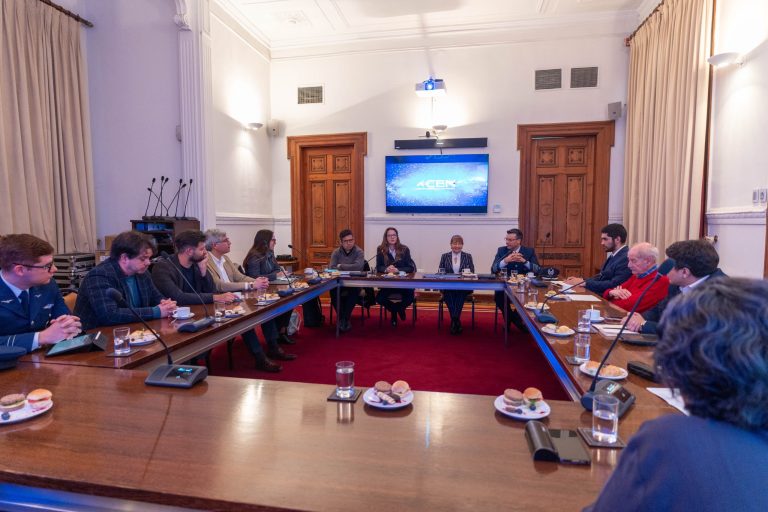



Bringing national scientific advances that use nanotechnology to provide solutions to the challenges of sectors such as construction, mining, agribusiness and food has been the main objective of the nanotechnology fair set up by CEDENNA, the country’s leading nanoscience and nanotechnology center.
The scientific exhibition was visited by a group of business people from the construction industry, in an initiative coordinated by the National Research and Development Agency, ANID, and the Chilean Construction Chamber, CChC.
On this occasion, CEDENNA’s director, Dr. Dora Altbir Drullinsky, presented various innovations such as mining sensors that improve productivity and safeguard workers’ safety, the production of nanoparticles for manufacturing nanomaterials, a pathogen sensor capable of detecting them in record time, and smart packaging with nanotechnology that extends shelf life while maintaining quality.
The scientist, 2019 National Science Prize winner, said: “we hope that the committed and excellent work we do here captures the attention of the private sector and inspires confidence that Chilean science is capable of solving problems of interest to different sectors of our country.”
Dr. Roberto Lavín, CEDENNA researcher and Director of the Institute of Basic Sciences at Universidad Diego Portales, presented nanotechnology concrete and nano asphalt, addressing their properties and benefits.
On the occasion, the Head of ANID’s Department of Development and Innovation Initiatives, Helen Ipinza Wolff, said “here at CEDENNA we find great installed capabilities, both in human capital and in equipment and infrastructure, to solve the challenges facing our country’s productive sectors. The invitation is to explore these capabilities to take advantage of nanotechnology solutions for our clients and for the national economy.”
Mariela Muñoz, Project Coordinator at the Technological Development Corporation (CDT) of the Chilean Construction Chamber, said “we are clear that the way forward is productivity and improving the environment and the circular economy this produces. It is therefore vitally important to see and understand that this can be achieved through research and development.” She highlighted the importance of synergy between companies, trade associations and academia in this regard.
CEDENNA was founded in 2009 and is one of Chile’s main multidisciplinary research centers. It is made up of more than 70 PhDs from various universities in the country and has capabilities available in its more than 17 laboratories.
OPEN LAB
On the occasion, Dr. Altbir commented that CEDENNA created a new strategic science-industry platform called OPEN LAB, which seeks to create a hub of partner companies to promote research and technological development to deliver innovative answers to the challenges of each sector.