


-
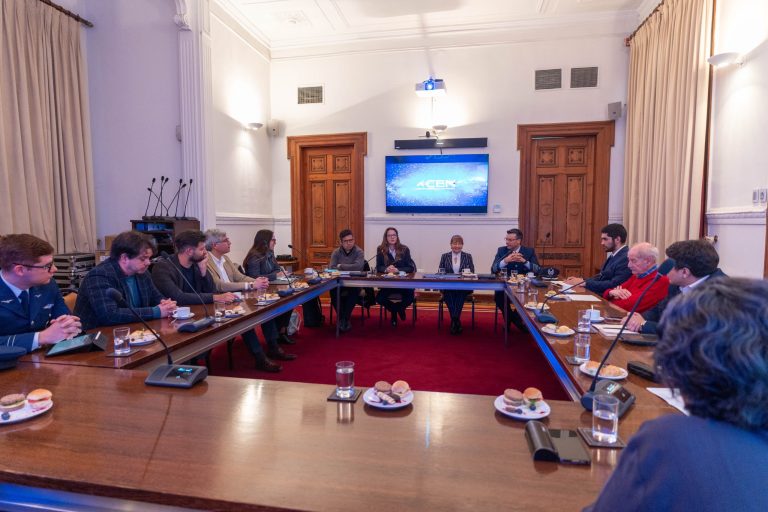
The Minister visited the Center for the Development of Nanoscience and Nanotechnology, CEDENNA, to learn about valuable innovations by its researchers to support the agricultural sector and improve food quality and safety.
-
“The scientists I met here are extraordinary men and women, with very strong research and product indicators and a great passion for the social value of what they are studying,” the minister said.
The Minister of Agriculture, Esteban Valenzuela, visited the country’s largest nanoscience and nanotechnology center, where he toured some of its laboratories and spoke with its researchers about agriculture-oriented developments, including a pathogen sensor capable of detecting them in record time, a sensor for detecting pesticides, smart packaging with nanotechnology that extends shelf life while maintaining quality, and humidity and temperature monitoring systems.
After touring CEDENNA, the minister praised the center’s work and highlighted that “food security implies the existence of healthy food that is economically accessible, as well as sovereignty, and it has to do with valuing soils and products and being careful; as they say worldwide, the only way to do serious agriculture today is to produce more with less. Use fewer resources and with greater precision, so what we have seen today is quite fundamental.”
In this regard, the minister said “we want to strengthen the Ministry of Agriculture’s work with CEDENNA. There are many projects related to food safety, and in this the Agricultural and Livestock Service plays a fundamental role, as do INIA, FIA and INDAP. Small farmers, communities and many women who add value to food ask us for help obtaining safety certification, which is a complex and expensive process, so it is important to achieve a technological transition that allows us to be equally rigorous and precise while giving tools to the smallest producers.”
CEDENNA’s director, Dr. Dora Altbir Drullinsky, National Prize in Sciences, said that “for us, welcoming the minister is tremendously relevant because we can show what we are doing thanks to the State’s support for and confidence in the science and technology
we can develop; but it also allows us to seek alliances to move from basic science to technology.”
She added that CEDENNA has a large number of products in the process of reaching the market, and these alliances are certainly very positive for finding other partners and companies that may be interested, as well as other problems we can address through nanoscience and
nanotechnology.
The executive director of the Foundation for Agrarian Innovation (FIA), Francine Brossard, said that “at CEDENNA there are projects we are reviewing with INIA, and with the technological side you are supporting, it turns out to be the perfect combination we need for the projects. At FIA our role is to drive innovation together with different stakeholders, and academia is key for that.”
Finally, Dr. María José Galotto, member of CEDENNA’s board, said that “the minister’s visit is super important for CEDENNA to show him the potential we have developed at the center and the new technologies that allow nanotechnology to be incorporated in different areas, in agriculture as well as in food and nanosafety. We were able to show what we do and also hear from him about other fields we could venture into, such as forestry and aquaculture, where nanoscience and nanotechnology developments can be transferred to support these fields.”
CEDENNA was founded in 2009 and is one of Chile’s main multidisciplinary research centers. It is made up of more than 70 PhDs from various universities in the country and has capabilities available in its more than 17 laboratories.
OPEN LAB
On the occasion, Dr. Altbir commented that CEDENNA created a new strategic science-industry platform called OPEN LAB, which seeks to create a hub of partner companies to promote research and technological development to deliver innovative answers to the challenges of each sector.
Finally, Dr. Dora Altbir stated: “we hope that the committed and excellent work we do here captures the attention of the private sector and convinces them to support and invest in national science and its developments, because Chile cannot and must not fall behind.”