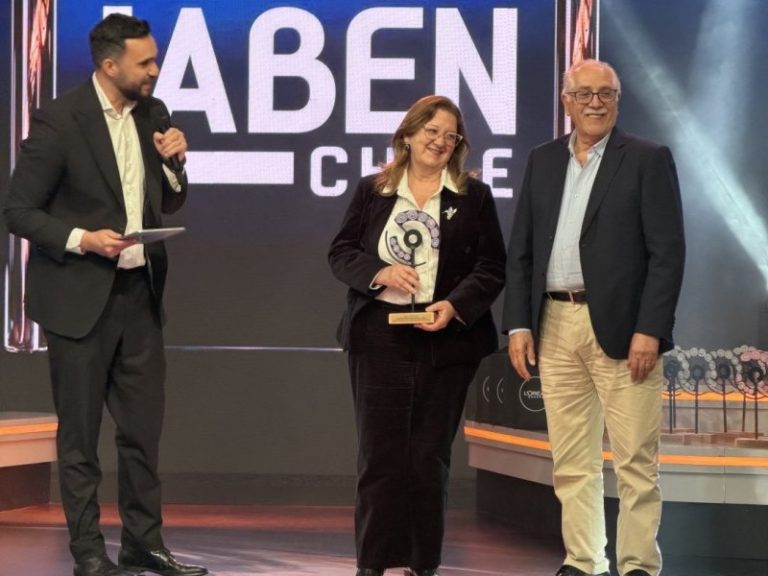



“Gender inclusion is not a concession, but a necessity for the comprehensive development of our society,” said the Director of the CEDENNA Foundation, Dr. Dora Altbir, as she welcomed guests to the commemoration that this entity promoting nanoscience and nanotechnology organized for International Women’s Day.
The activity, led by the executive director of the CEDENNA Center, Dr. Juan Escrig, was attended by ANID’s Deputy Director of Research Centers, Nicole Ehrenfeld; Francisco Zambrano, Secretary General of Usach; the dean of the Faculty of Chemistry and Biology, Dr. Leonora Mendoza; the dean of the Faculty of Medical Sciences, Alejandro Guajardo; the head of ANID’s Department of Development- and Innovation-Oriented Initiatives, Helen Ipinza; and Katherine Leveman, executive of ANID’s Centers Subdirectorate.
Female leadership: the pending challenge
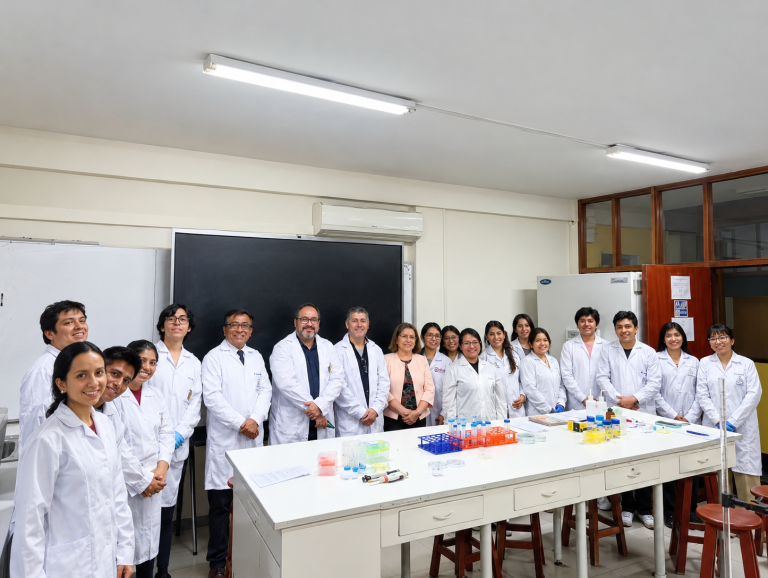
After visiting the laboratories to learn about the cutting-edge research carried out by this basal center, the ANID representatives went to the auditorium for a meeting with the CEDENNA community, where Nicole Ehrenfeld thanked them for the opportunity to recognize the work of women researchers, “especially in a center as cross-cutting and multicultural as CEDENNA”.
“For ANID and the Associative Research Centers Subdirectorate, it is essential to promote gender equity, and for that it is important to recognize the challenges that are still pending. Despite the many advances Cedenna demonstrates, there are still significant barriers nationwide that hinder the participation and recognition of women in this field, including the gender gap in leadership,” she said, referring especially to “the underrepresentation in specific research areas, many of which are related to key industries in our country. In this context, promoting women’s equitable participation in all roles, and particularly in leadership and decision-making in the scientific community, is not only an imperative of justice, but is key to driving innovation”.
Ehrenfeld stated that, in this state agency, and especially in the Research Centers Subdirectorate, the need to actively address the challenge of gender equity is very present. “Only with equal opportunities will we be able to count on all capabilities in the present and future of our research. And in that sense, the effort of institutions, society as a whole and all of us is required to break down the barriers that still persist,” she concluded.
Promoting STEM careers among girls and young women
In their remarks, the attending authorities agreed on highlighting that in science and technology it is essential to promote gender diversity beyond minimum standards and to reflect on the many challenges still pending.
They also agreed in stressing that some very simple measures adopted at this Center, such as a focus on results rather than on working hours, have made it possible to achieve a level of female participation unprecedented in the country.
“Fourteen years ago we started CEDENNA, deeply committed to this equity, within a framework of recognition of our achievements as women in science and technology. Some simple measures we have taken at our center, such as a focus on results rather than on working hours, have made it possible —even though CEDENNA is a STEM center— for 50% of our students to be women. This is a level of female participation unprecedented in the country,” said Dr. Altbir.
The Foundation’s director also recalled that CEDENNA was a pioneer in pushing, in 2007, for the university to provide coverage and funding for pre- and postnatal periods for doctoral and postdoctoral fellows, a condition that the then CONICYT later adopted and which is now part of the culture of several universities.
“Today, it is crucial not only to recognize these contributions but also to ensure that no woman or girl is limited by gender prejudice or by false incompatibilities between her personal and professional aspirations. Every woman who decides to pursue a STEM career breaks barriers and builds a bridge for those who will come after her,” concluded Dora Altbir.