




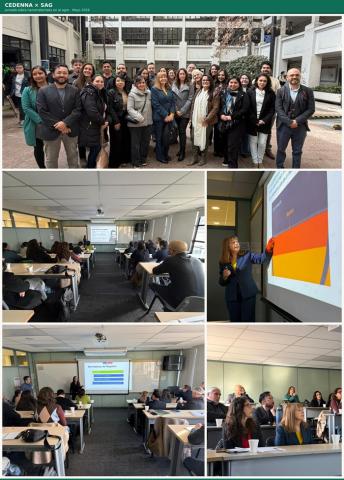
In a meeting that marks the beginning of a strategic collaboration between applied science and public regulation, the Center for Nanoscience and Nanotechnology, CEDENNA, and the Agricultural and Livestock Service (SAG) took the first formal step towards joint work to address the safe and regulated use of nanomaterials in the Chilean agricultural sector. The meeting brought together SAG technical teams and CEDENNA researchers to explore the opportunities —and challenges— presented by nanotechnology applied to fertilizers, pesticides and veterinary medicines. What was put on the table was not only frontier science, but something more urgent: the need for Chile to develop its own capabilities to identify and regulate nanomaterials, before regulations are imposed from abroad. In this context, CEDENNA offers something no other institution in the country can: it has the only certified test in Chile to evaluate the toxicity of nanomaterials, with NCh-ISO/IEC 17025:2017 accreditation granted by the National Standards Institute (INN) and under the international standards defined by the OECD. Added to this is a network of specialized laboratories and the experience of 57 researchers from 18 universities, from the Arica y Parinacota Region to La Araucanía.
An alliance with concrete impact for agriculture
For Lucía Valenzuela, Head of the SAG Pesticide Authorization and Evaluation Subdepartment, the meeting opened a window of technical understanding that did not exist before: “It is a very relevant opportunity for my team, because we can better understand what nanoparticulate material is and face the regulatory challenge this represents”.
Carlos Lecaros, also from SAG, was direct in pointing out the strategic value of this alliance: “Collaborating with CEDENNA is very important for SAG because we can obtain grounded information and draft regulations that are more consistent with our soils and our agriculture. These meetings enrich us as an institution”.
The animal health dimension was also present. Carolina Marambio, Head of the SAG Veterinary Medicines Registration and Control Subdepartment, highlighted the potential of new technological developments to strengthen national production and the country’s export effort: “Taking part in collaboration between academia and our Service creates links and allows us to advance in new technologies that can result in solutions that improve animal health, with safe and effective products that support national production and the country’s export effort”.
Chile needs its own regulations
One of the most resonant messages of the day came from CEDENNA researcher Dr. Manuel Gacitúa, who described the meeting as the necessary union of two worlds that rarely talk in depth: “There are two worlds meeting here: the academic-scientific world and the technical-regulatory world. And that combination simply has to be virtuous. Academia can offer new ideas and SAG has new needs”.
His call was unequivocal: “Let’s not wait for regulations from a developed country to reach us. We have our land, our agriculture and our needs. Therefore, we need to develop our own capabilities and regulations”.
This position is aligned with the current imperative for Chilean science to achieve effective transfer to the country: for the knowledge generated in centers of excellence to be translated into concrete tools for public services, industry and national development.
CEDENNA puts its unique capabilities at the service of the country
CEDENNA Director Dr. Dora Altbir stressed the inaugural —and promising— nature of this link: “This activity is the first step in a collaboration between SAG and CEDENNA to advance the safer use of nanoparticulate materials in the Chilean agricultural system”.
The Center does not only carry out research: it offers SAG and the productive sector the possibility of having internationally certified toxicity results, backed by the only accredited laboratory in Chile for this type of testing. A capability that, in the context of growing global regulatory requirements for nanomaterials, becomes a strategic advantage for Chile as an exporting country. In addition, CEDENNA represents Chile in the OECD Working Party on Manufactured Nanomaterials, where global standards for the regulation, analysis and characterization of nanomaterials are defined. What is agreed there is directly relevant to Chilean national legislation.
Real technology transfer: from the laboratory to public policy
This type of collaboration represents exactly what Chilean science policy demands today: that investment in excellent science translates into concrete value for the country, with knowledge reaching the services that regulate what Chile produces, exports and consumes. In a context in which Chile seeks to consolidate its position as a reliable exporter of food and agricultural products, having its own regulations, based on scientific evidence generated in the country and validated with international standards, is a long-term competitive advantage.
CEDENNA is the Center for Nanoscience and Nanotechnology, created in 2009 as an ANID Basal Center and hosted at Universidad Diego Portales (UDP). It brings together 57 researchers from 18 universities across the country, integrating physicists, chemists, biologists, physicians and engineers in frontier scientific projects, with laboratories and collaborations from the Arica y Parinacota Region to La Araucanía. It has the only certified test in Chile to evaluate the toxicity of nanomaterials, under OECD standards.
May 20, 2026
The joint work between CEDENNA and SAG is, in this sense, a model of what the relationship between academia and the State should be: not an occasional or protocol relationship, but a sustained technical alliance aimed at solving real problems with first-rate science.


