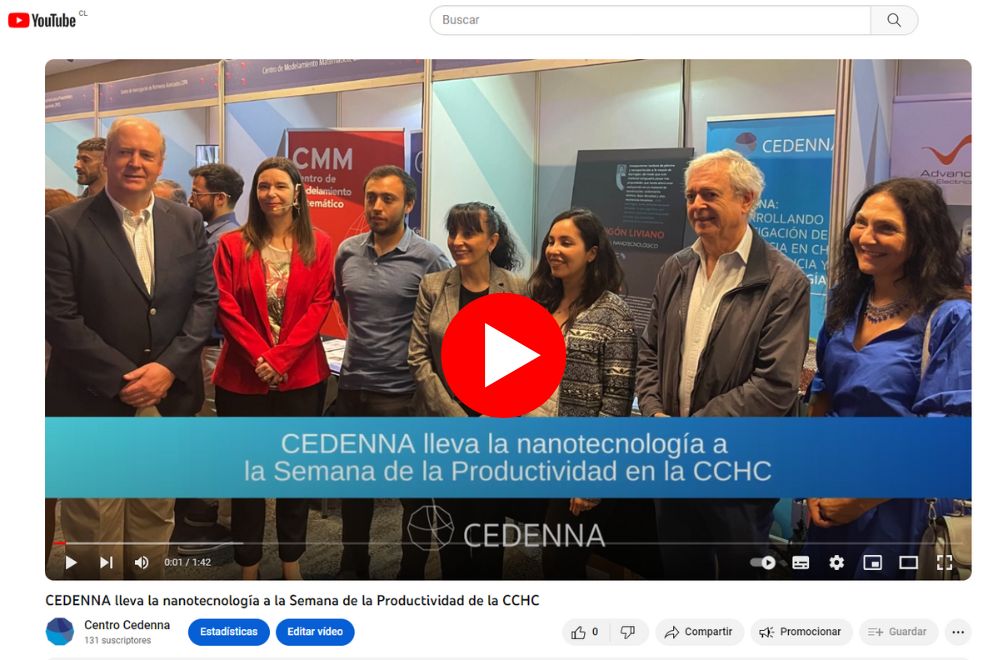
With nanotechnological concrete and the measurement of risks associated with airborne particulate matter in construction environments, the stand of the Center for Nanoscience and Nanotechnology, CEDENNA, attracted the interest of attendees on the last day of the third edition of Productivity Week, organized by the Chilean Chamber of Construction (CChC) in partnership with the National Research and Development Agency (ANID).
Helen Ipinza Wolff, head of ANID’s Department of Development- and Innovation-Oriented Initiatives, highlighted the importance of this event, in which 11 research centers took part: “Our goal is to spark a productive link between industry and our researchers, so that we can contribute science-based innovative solutions and take on ever more complex major challenges”,
She added that CEDENNA, with its advances in nanotechnological concrete and nanoparticles, is a clear example of how nanoscience can improve aspects such as thermal insulation and health. “But beyond that, other great opportunities are opening up because CEDENNA has shown it has a very powerful team for technological developments based on nanotechnology and nanoscience,” she said.
Mariela Muñoz, Human Capital and Academia Leader at the Technological Development Corporation (CDT) of the Chilean Chamber of Construction, highlighted that cooperation with ANID and centers like CEDENNA is crucial to understand how nanotechnology can improve productivity and sustainability in construction. “CEDENNA has proven to be a leader in developing nanotechnological concrete and other innovative products that turn waste into valuable productive processes,” she noted.
At the center’s stand, Dr. Mauricio Escudey, director of CEDENNA’s Nanosafety Unit, explained that on this occasion the emphasis was on the center’s capacity to carry out crucial measurements in construction, especially in monitoring and managing risks associated with airborne particulate matter.
“What we are showing on this occasion,” said the researcher, “is how we can measure, how we can quantify the size of that particulate matter and the risks that may be associated with it. With that information, we can link the level and quality of protection that those working in the environment where all that movement is taking place should have”.
Nanotechnological concrete
Nanotechnological concrete, an innovation presented at Productivity Week by the Center for Nanoscience and Nanotechnology, is the result of extensive research led by Dr. Roberto Lavín, scientist at the center and Director of the Institute of Basic Sciences at Universidad Diego Portales (UDP).
This development not only represents a major advance in construction, but also exemplifies the transformative potential of nanotechnology in industry. The research by Dr. Lavín and his team has made it possible to create a material that redefines the limits of traditional concrete, driving more effective and environmentally sustainable solutions.
Characteristics:
- Structural insulator: This concrete meets the Chilean standard requirements to be classified as structural nanotechnological concrete. Its density allows it to be classified as lightweight or thermally insulating, making it an ideal option for applications requiring both structural strength and thermal insulation properties.
- Appearance and weight: Although it looks like conventional concrete, it is noticeably lighter. This does not compromise its mechanical strength, which is similar to that of traditional concrete, making it versatile and adaptable to different construction needs.
- Strength and durability: It has a low density but maintains high strength, giving it a significant advantage over conventional concrete. This combination of lightness and strength is a direct result of incorporating nanometric technologies into its composition.
- Customization according to construction requirements: The ability to produce this concrete in different mix designs according to the specific needs of each project makes it exceptionally adaptable. This flexibility is crucial to meet the various challenges of the construction sector.
Impact on Construction
This concrete not only meets the technical requirements of the construction industry, but also represents a significant advance in terms of environmental sustainability. Being lighter, it reduces the consumption of materials and energy in its production and transport, contributing to greener and more efficient construction.
This development reflects CEDENNA’s commitment to innovation and sustainability, showing how advanced science can be applied to improve quality, efficiency and environmental responsibility in construction. The introduction of this nanotechnological concrete to the market is a step forward towards a future of safer, more durable and more environmentally friendly construction.
WE INVITE YOU TO WATCH A VIDEO OF THIS ACTIVITY: