

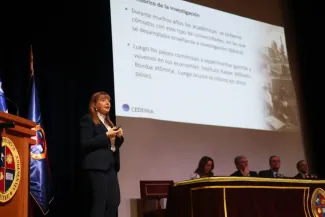
The director of CEDENNA presented “The invisible revolution: nanotechnology for Chile’s development” during the academic ceremony for the university’s 37th anniversary. In her presentation she showed developments made at CEDENNA and addressed the challenges of turning scientific knowledge into solutions for society and the productive sectors.
With an invitation to discover the properties that emerge at the smallest scale of matter, Dr. Dora Altbir Drullinsky, director of the Center for Nanoscience and Nanotechnology, CEDENNA, gave the keynote lecture at the academic ceremony for the 37th anniversary of the Universidad de los Andes. The presentation, titled “The invisible revolution: nanotechnology for Chile’s development”, brought together scientific concepts, figures on the progress of this field worldwide and examples of technologies developed by CEDENNA researchers, an applied research center funded by the National Research and Development Agency, ANID. During her talk, Dr. Altbir explained that a nanometer is one billionth of a meter and that, at that scale, materials can acquire properties different from those they have at larger dimensions. One of the examples discussed was carbon. While in some of its forms it is a soft material, when organized as graphene it can reach a strength about 200 times greater than steel. These variations make it possible to design materials and devices with applications in health, mining, food, energy, construction and the environment.
Nanotechnology developed in Chile
The director of CEDENNA argued that nanotechnology is not an isolated industry, but a platform that is integrated into different products and processes. It is currently present, among other applications, in RNA vaccines, screens, batteries, sensors and new materials. In this context, she presented a selection of technologies developed in Chile by teams linked to CEDENNA. These include sensors to detect substances of interest to mining, packaging with new properties for the food industry, magnetic nanoparticles studied for cancer therapies using hyperthermia, technologies aimed at the early detection of Parkinson’s disease and concrete with thermal insulation capacity. These examples show that the scientific capabilities exist. However, turning research into an available solution requires a path that includes research, prototype development, validation, production scale-up and adoption by companies, public institutions and users. Dr. Altbir noted that this process does not depend solely on universities. It requires sustained collaboration between scientific centers, companies, laboratories, public bodies and potential users, with responsibilities that change at each stage, but with coordination that must be maintained throughout the entire journey.
The investment gap in research and development
The presentation also addressed the differences between Chile and countries with greater scientific and technological capabilities. While Chile allocates about 0.4% of its gross domestic product to research and development, the average for OECD countries is approximately 2.7%. This gap hinders the continuity of projects, the training and retention of specialized teams, access to equipment and the progress of technologies from the laboratory to their use in real conditions. The director of CEDENNA argued that scientific capabilities take years to build and require a long-term view. Therefore, funding for science and technology cannot depend solely on short cycles or isolated initiatives, especially when the country seeks to increase its productivity, add value to its resources and respond to its own problems. At the end of her presentation, Dr. Altbir summed up this challenge with an invitation addressed to the whole country:
“Science can open the way. As a country, we must decide to follow it.”
Anniversary academic ceremony
The keynote lecture was part of the ceremony with which the Universidad de los Andes commemorated its 37th anniversary. During the event, the Universidad de los Andes Gold Medal was also awarded, on an extraordinary basis, to the priest, philosopher, poet, literary critic and academic Fr. José Miguel Ibáñez Langlois. The ceremony also included the recognition of 18 new full professors and the presentation of the University Advisor award to faculty in the areas of Engineering, Business Administration and Bachelor’s Program, Humanities and Health Sciences. On that occasion, Rector José Antonio Guzmán stated in his speech, as he has on other occasions, that the “University is a bridge between the past and the future, and a bridge is supported at both ends: if we let go of tradition we are adrift, and if we stop looking ahead we become a museum”. He went on to say that “today I want to add something this time has taught us: a bridge, in addition to being supported at both ends, has to be made of a single piece. A bridge made of loose parts cannot bear anyone’s weight. The strength of this institution lies not in how many things it does, but in doing them from a unifying perspective”.