



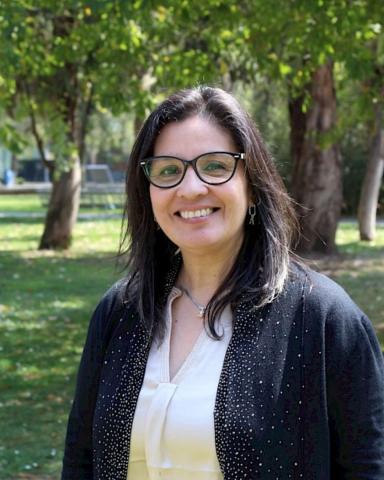
The Dr. Mónica Paulina Antilén Lizana, a distinguished Chilean chemist, academic and researcher at the Center for Nanoscience and Nanotechnology, CEDENNA, was recently recognized internationally for her extensive career in soil science and chemistry, with special emphasis on volcanic matrices and sustainability. She will join the board of the International Humic Substances Society (IHSS) for the 2026-2030 period, one of whose objectives is to promote the scientific development of young Latin American researchers. She draws on her own experience to reflect on this task, especially with regard to women.
“I came to Chemistry directly thanks to a school teacher. And over the years, talking with many colleagues, I have realized that this is something that is repeated in almost all scientists. A teacher, a school experience, the wonder caused by some natural event or simply childhood curiosity about their environment has been key to their career development”, says Dr. Antilén, who is also director of the Institute for Sustainable Development of the Pontificia Universidad Católica de Chile.
“That is why I believe that one of the most important tasks we scientists should undertake is working with the youngest, with children, because that is where —what for us may be just another talk— becomes, for two or three of those listening, the push they need to get excited and steer them towards a scientific career. And that alone would already be contributing to improving our environment and our country”, she stresses.
–Once you chose Chemistry and developed your career, what led you to nanoscience?
“Because Nanoscience is the science of the future! –she laughs, raising her arms– When I joined the research group led by Professor Mauricio Escudey (CEDENNA researcher, nanosafety expert and Chile’s representative at the OECD), I became enthusiastic about soil chemistry, understood its importance for human and productive development and have never stopped researching what I found there”.
Bill
Mónica Antilén has been a professor for 23 years and has spent 20 of them researching the physicochemical behavior of organic and inorganic contaminants on different types of surfaces, especially in our country’s volcanic soils. She has more than fifty scientific publications on the environmental impact caused by heavy metals and veterinary antibiotics in soil, analyzing the role of natural organic matter and clays.
“Micro- and nanoplastics have been studied in marine systems, but not in soils, and we want to establish what happens to contaminants; their interaction with other contaminants; what happens to microbial communities, etc. I know this may seem remote, but, just like fungicides and pesticides with nanoparticles, plastics are often used at different stages of cultivation and harvest. And these microplastics and nanoparticles remain in the water and soil with effects that are often very harmful. We have to get ahead of that”, she explains.
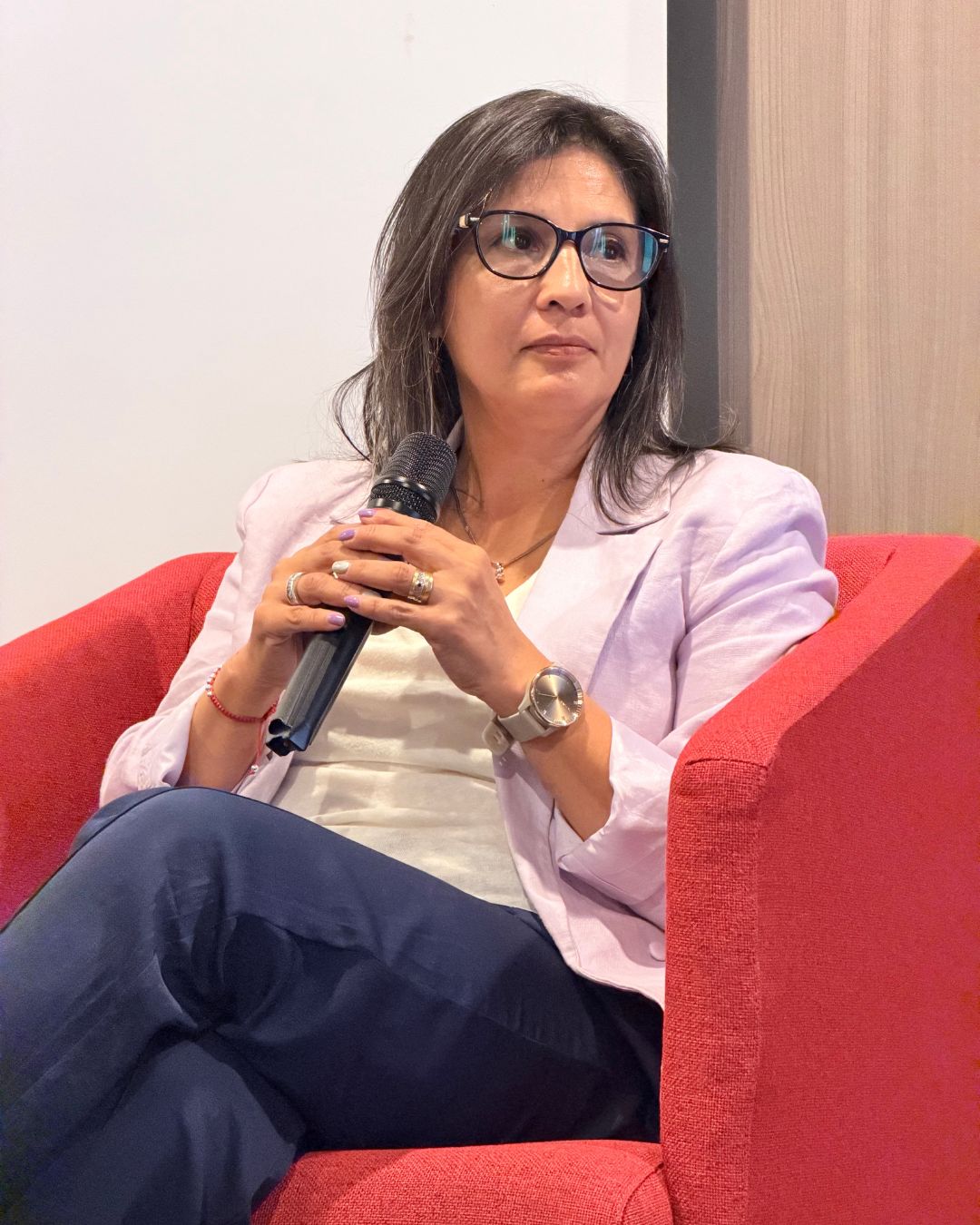
This work is what the international society IHSS, made up of leading researchers on natural organic matter, soil, water and air, recognizes in welcoming her, as well as her contributions with economic impact in the country, such as the Soil Law, which is currently pending in Congress “and which we will keep working on, especially in the Agriculture committees, which I hope will give this task every push until it is enacted”, she affirms.
A challenge for women
Dr. Antilén acknowledges that there are barriers for women in science, but thinks that, fortunately, there are fewer and fewer, especially with essential legal support such as childcare.
“It hasn’t been easy, but I am optimistic by nature and I am very enthusiastic about what I do. There are difficult moments, of course, such as balancing family and relationships with a demanding career and working hours that require essential support”. She adds that “there are difficulties at different stages. For example, when there are competitions or research positions that require traveling across the country, as in our field, it is one more barrier for those who are mothers or caregivers”.
She fondly remembers the students who dared to accompany her on her projects, even when they received no pay.
“Many women work in Chemistry, but very few reach decision-making and senior positions, because that is also another space where family responsibilities and how scientists value your leadership weigh heavily. A firm man is a leader. A firm woman is arbitrary. And this is not just in science, it is in all of society. ‘She is harsh, intransigent… He leads with firmness’ is often heard. In laboratories too”.
That is why she is happy when she sees students who manage to pursue a career like hers, which has now reached the international level. “But we all get older, and if we don’t make sure we have an equally committed next generation, we put our contributions at risk”.
This is one of the reasons why she particularly likes the work that the International Humic Substances Society (IHSS) does by providing scholarships and internships, as well as a travelling award so that young scientists can attend conferences of global relevance and keep up with the constant advances in their disciplines.
“For me, the most important thing is to have an impact on children”, she says finally, recalling her experience in rural schools in the north and in the Mapuche area, with the importance that land has for Indigenous peoples. “Being able to help children value science and the land they live in, and this wonderful possibility that allows me to experience it with them”, she concludes.


