



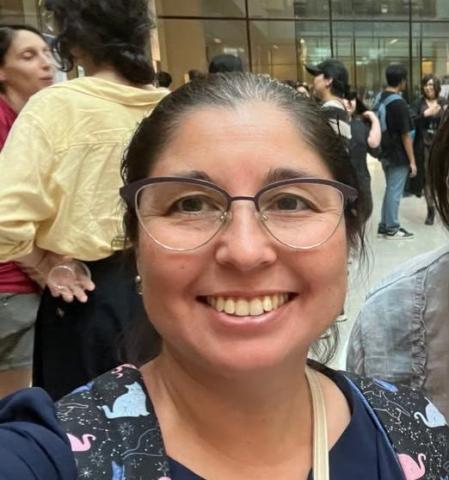
Dr. Daniela Alburquenque Muñoz, researcher at CEDENNA and the Center for Applied Nanotechnology of the Universidad Mayor, will lead, together with Dr. Chandra Kumar (School of Engineering at the same university), an inter-university project aimed at developing materials to improve the performance of lithium-ion batteries and supercapacitors.
The initiative was selected in the fourth edition of the Inter-University Associative Research Initiation Competition, which received 27 applications and funded six projects for a total of CLP 90 million. The network behind the competition brings together eight Chilean universities and seeks to promote research carried out by teams from different institutions.
The project, titled “Experimental and theoretical studies of spinel/MoS₂ heterostructures to improve electrochemical kinetics and conductivity in electrodes applied to supercapacitors and lithium-ion batteries”, will be carried out by specialists from the Mayor, San Sebastián, Adolfo Ibáñez and Autónoma de Chile universities.
The research will study heterostructures that combine spinel-type metal oxides with 1T-MoS₂, a two-dimensional material made up of extremely thin layers. The combination seeks to facilitate the movement of ions and electrons within the electrodes, one of the factors that determines the storage capacity, charge and discharge speed and stability of the devices.
The team will address the problem through the synthesis and characterization of new materials, electrochemical tests and theoretical calculations based on Density Functional Theory, known as DFT. These tools will be complemented by the use of artificial intelligence to analyze and relate the structural, electronic and electrochemical properties of the materials studied.
As Dr. Alburquenque explained, the aim is to take advantage of the complementary properties of both materials to favor charge transport and improve the performance of batteries and supercapacitors. The researcher also highlighted the value of the scientific networks generated through projects of this type, which, in her words, “go beyond the project”.
Lithium-ion batteries store energy through the movement of ions between their electrodes and are used in cell phones, computers, electric vehicles and systems associated with renewable energy. Supercapacitors, meanwhile, can deliver and receive energy quickly, so they are used in applications that require frequent charge and discharge cycles.
The project will seek to advance materials that combine greater storage capacity with faster charging processes and better stability during use. These challenges are part of current research in energy storage, especially given the growth of technologies that need more efficient and longer-lasting devices.
The research is directly related to Daniela Alburquenque’s work at CEDENNA. The scientist specializes in solid-state physical chemistry, synthesis and electrochemical characterization of nanostructured cathode materials, and development of materials for lithium-ion batteries.
The award will make it possible to bring together experimental and theoretical capabilities from four universities and advance research that connects nanoscience, materials science, electrochemistry, computational modeling and artificial intelligence.
For CEDENNA, the participation of one of its researchers in this initiative also strengthens collaborative work with other scientific groups in the country and contributes to the development of knowledge and materials applicable to new energy storage technologies.


