

-
Dr. Juliano Denardin studies how the curvature and geometry of nanometric structures can generate new applications in data storage, sensors and computing technologies
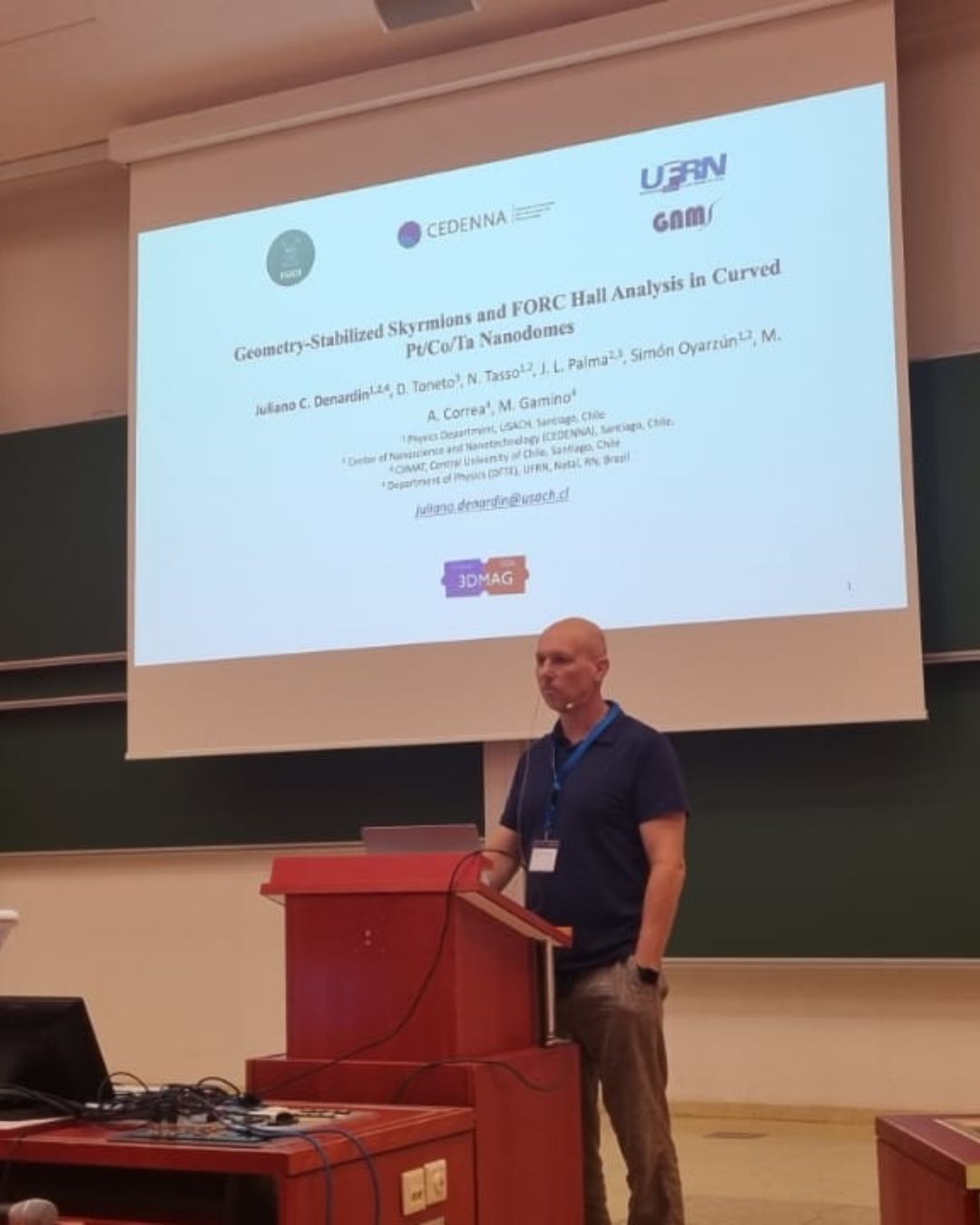
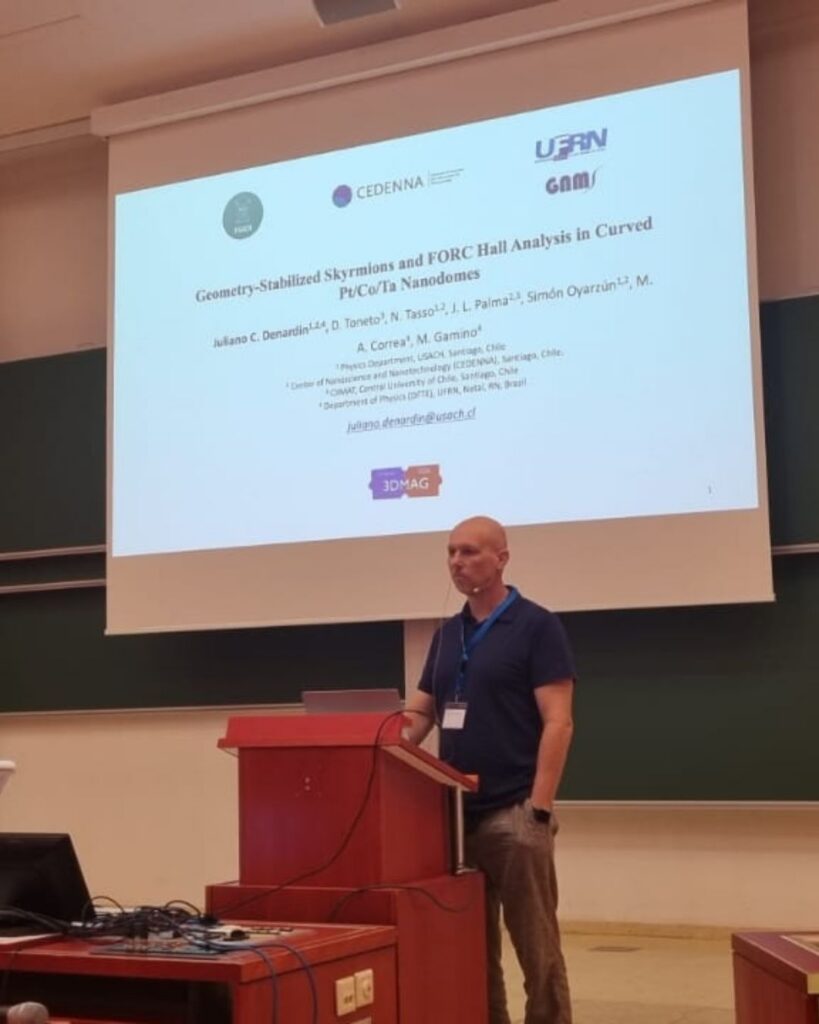
Cedenna researcher and academic at the Department of Physics of the Universidad de Santiago de Chile, Dr. Juliano Denardin, took part in the First International Symposium on Three-Dimensional Nanomagnetism (“3DMAG 2026”), held from July 13 to 17 in Vienna, Austria.
3DMAG 2026 was the first edition of this international symposium dedicated exclusively to three-dimensional nanomagnetism and brought together specialists in nanofabrication, magnetic characterization, theoretical modeling, spin topology, magnetization dynamics, spintronics and magnetic nanodevices.
Dr. Denardin was the only South American whose work was presented at the international scientific event, which he described as “an excellent opportunity to hear from leading scientists in nanomagnetism and spintronics, visit state-of-the-art laboratories (such as those of the 3DNano group), talk with other researchers and discuss possible international collaborations”.
A line of research with future applications
The Cedenna researcher presented the work “Geometry-Stabilized Skyrmions and Forc Hall Analysis in Curved Pt/Co/Ta Nanodomes”, which addresses the behavior of magnetic structures known as skyrmions on curved surfaces formed by nanodomes and coated with layers of platinum, cobalt and tantalum.
This is a field of research that studies how incorporating these new shapes and topologies can generate physical behaviors that do not appear in two-dimensional systems and can contribute to the development of information storage technologies, sensors, spintronic devices, unconventional computing and applications related to biomagnetism.
The study presented by Dr. Denardin is related to the search for new ways to control extremely small magnetic structures by designing their geometry. Skyrmions are stable configurations of a material’s magnetic moments and are being investigated for their possible use as information units in future data storage and processing devices.