

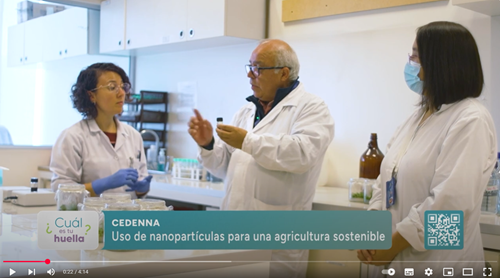
An innovative strategy to address the challenges of sustainable agriculture was presented in the latest episode of the program What is your footprint?, broadcast by TVN and Canal 24 Horas, which highlights the work led by Dr. Gustavo Zúñiga, academic at the Faculty of Chemistry and Biology of the Universidad de Santiago de Chile (Usach) and researcher at the Center for Nanoscience and Nanotechnology (CEDENNA).
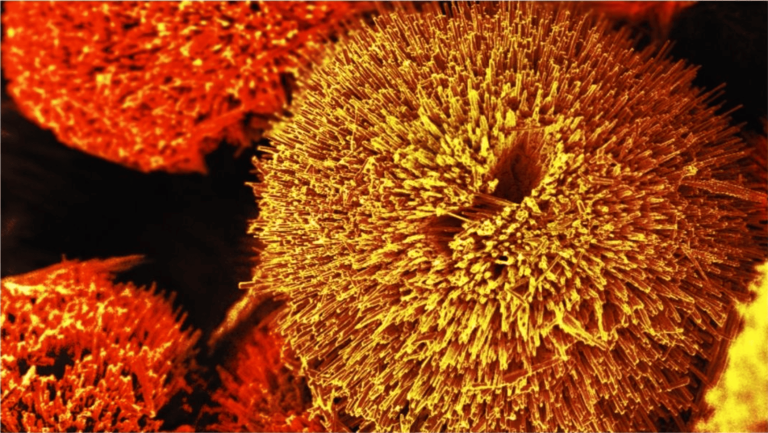
The research consists of developing plant-based nanoparticles through a green synthesis process, using extracts from native and Antarctic plants such as boldo, maqui or quillay. These nanoparticles make it possible to produce natural, chemical-free fertilizers and pesticides that leave no residue and can even be applied during post-harvest.
“Our approach in the agricultural field is based on the development of a biotechnological tool that allows us to produce plant material efficiently and sustainably”, explained Dr. Zúñiga during the report.
The team has worked for years to perfect in vitro culture protocols for plant species that contain active ingredients capable of filtering ultraviolet radiation, which opens up possibilities for agricultural as well as cosmetic or dermatological applications.
“One of the plants that grows in Antarctica, which we have managed to produce under laboratory conditions, accumulates substances that filter UV radiation. With this knowledge it is possible to create formulations that are stable, efficient at control and have low environmental impact”, said the researcher.
The nanoparticles are obtained through a technique known as “green synthesis”, which does not use toxic reagents, making it possible to create products that are safer for the environment and people.
“This synthesis is harmless to the environment. What we do is take the plants we grow in the laboratory, macerate them with hot water and extract compounds with high reducing power, which allow us to generate nanoparticles, mainly of iron oxide”, said Zúñiga.
These nanoparticles have proven effective as nanofertilizers and nanopesticides, with concrete applications in the post-harvest period, preventing the appearance of fungi and extending the shelf life of fruits and vegetables without leaving toxic residues.
“Many of these products can be used post-harvest. Since they are natural, they leave no residue and prevent fungi from developing while the fruit is stored”, he emphasized.
Finally, the researcher highlighted the contribution of nanotechnology to moving towards cleaner agriculture, aligned with the country’s environmental challenges:
“Working towards cleaner agriculture, not only in terms of products but also of the environment, is clearly a solution that can have an impact in a country like ours, which depends heavily on agriculture”, he concluded.
The full episode is available on the official channel of What is your footprint? on YouTube:
? https://www.youtube.com/watch?v=r_BjAEfH_W4