



Image description:
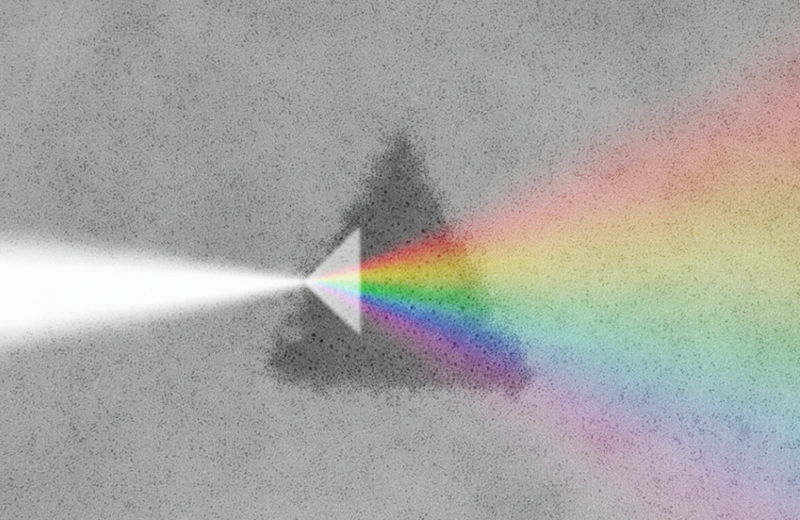
This image, which you discover in the calendar for September and October, shows allophane nanoparticles, nanometer-sized mineral components of soil (3 to 7 nanometers) that can retain water and nutrients and help improve soil fertility. Their arrangement recalls the halo of light that splits when passing through a prism, evoking one of Pink Floyd’s most iconic album covers and showing how science also converses with art.
Authors: Manuel Gacitúa and Ignacio Mateluna.
TEACHING ACTIVITIES
Suggested level:
7th grade to 10th grade (2° medio)
Subject:
Natural Sciences / Physics
Learning Objectives
- Natural Sciences, 7th–8th grade:
Explain phenomena associated with light. - Natural Sciences, 9th–10th grade:
Analyze how science makes it possible to develop new technologies.
Key concepts
Light · Spectrum · Materials · Technology
Light can also be designed
Students observe the image and recognize the phenomenon of light dispersion. Then, through a simple experiment (a prism, a CD or a glass of water), they observe how light separates into colors. The teacher explains that nanoscience makes it possible to create materials that control light for different technological uses.
Questions for reflection
- How does light behave when it interacts with different materials?
- Where do we see applications of this in daily life?
- Why is studying light important for technology?
:::::::::::::::::::::::::::::::::::::::::::::::::::::::::::::::::::::::::::::::::::::::::::::::::::::::::::::::::::::::::::::::::::::::::::::::::::::::::::::::::::::::::::::::::::::::::::::::::::::::::::::::::::::::::::::::::::::::::::::::::::::::
Below we invite you to watch the video in which the researchers who created this image explain what their work involved and how they did it.
