



Rebellious magnetizations
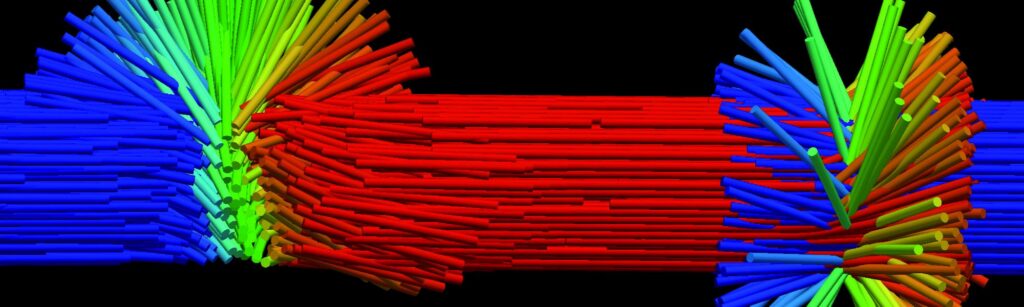
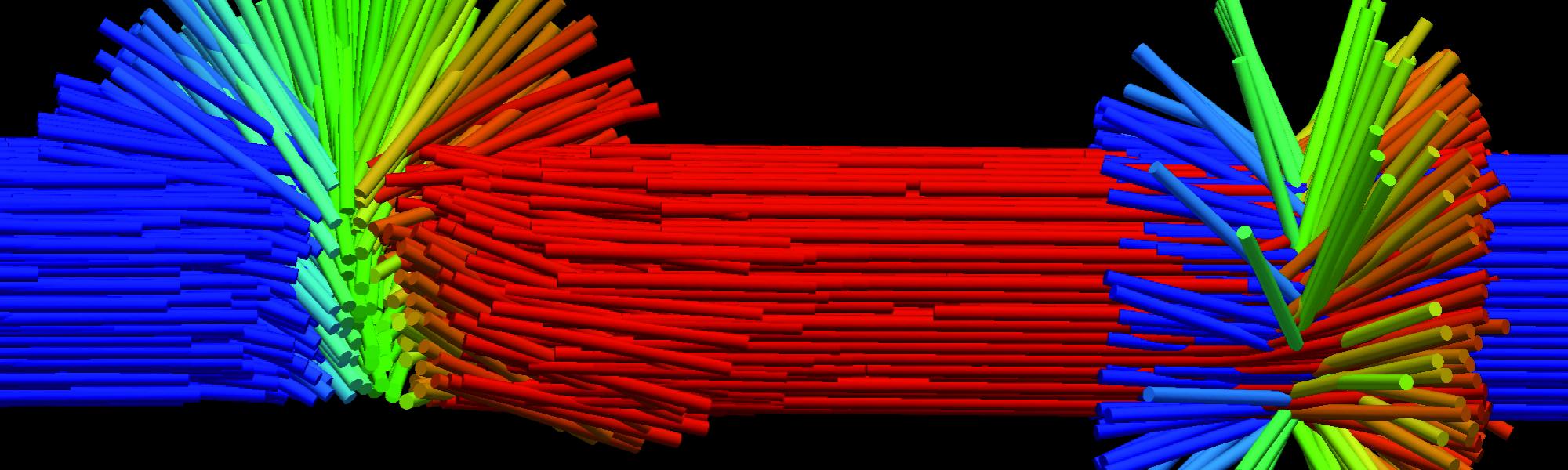
Simulation of magnetic orientations in a cylindrical magnet with a solid segment on the left and a tubular segment on the right.
An introduction to nanoscience and nanotechnology, explaining what happens to materials at nanometric scales and why those properties open up new applications.
Nanoscience is the study of what happens to materials that are very, very, very small, invisible to the naked eye and only observable with specialized microscopes. Formally, nanoscience studies systems or materials measuring less than 100 nanometers, that is, so tiny that they barely reach a few millionths of a millimeter.
To grasp these dimensions, imagine dividing one millimeter into a million equal parts: each of those parts is a nanometer. At these dimensions, materials can be seen through electron microscopes, that is, microscopes that use a beam of electrons.
But what makes materials so special at such small sizes? It is the number of atoms on the surface, that is, the atoms that, instead of being hidden inside the material, become exposed when the material is divided into small sizes.
Surface atoms are more reactive than those hidden inside. That is why, at nanometric sizes, properties emerge that differ from those materials show at larger sizes, and the study of these novel properties gives rise to nanoscience.
Nanotechnology refers to the applications created from discovering or harnessing the properties of materials at the nanometric scale. The applications made possible by knowledge of these new properties give rise to nanotechnology, and some have long been implemented in the devices we use, such as memory storage in computers or mobile phones.
One of the main characteristics of nanotechnology is that it is a multidisciplinary activity, involving disciplines such as physics, chemistry and biology. Because of the impact of its development, it is considered one of the main drivers of the Fourth Industrial Revolution.
Simulation of magnetic orientations in a cylindrical magnet with a solid segment on the left and a tubular segment on the right.