

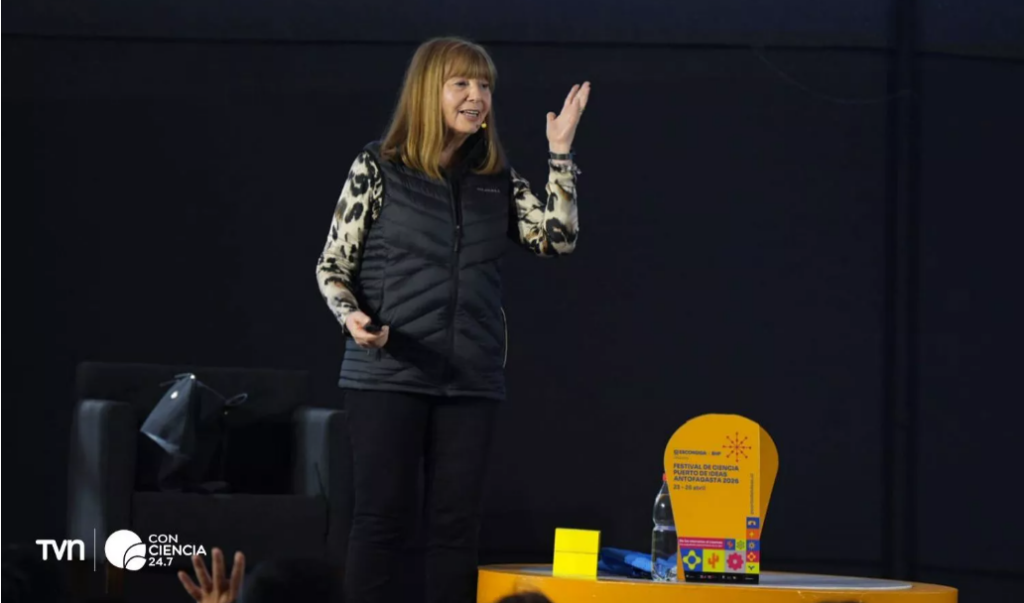
- Channel 24 Horas highlighted the participation of the director of the Center for Nanoscience and Nanotechnology, CEDENNA, at Puerto de Ideas in Antofagasta
Is nanotechnology present in our daily lives? Physicist Dora Altbir, Chile’s 2019 National Prize for Exact Sciences winner, says the answer is clear: yes, and for much longer than we think. In her talk “When the smallest things change the world”, presented at Puerto de Ideas Antofagasta 2026, the academic explained how the study of the tiny, at the nanoscale, is transforming key areas such as medicine, energy and industry.
The nanotechnology studies materials with dimensions smaller than 100 nanometers, that is, one billionth of a meter. Although nanoparticles have always existed in nature, for example in candle smoke, only in recent decades has science managed to control them: defining their size, composition and behavior.
One of the most surprising aspects is that materials behave differently at the nanoscale. As sizedecreases, the surface-to-volume ratioincreases, which modifies key properties such as strength, color or conductivity. Altbir illustrated this with carbon:
- In the form of common coal: it is soft and generates heat.
- As fullerene (nanoscale): it is highly resistant and works as a lubricant.
- As graphene (a nanometric layer): it is stronger than steel and can conduct electricity.
- As carbon nanotube (nanometric tube): it is lightweight, thermally stable and an excellent conductor.
Applications that are already changing the world
The nanotechnology already has concrete applications in different fields:
- Medicine: cancer treatments using hyperthermia with nanoparticles.
- Energy: development of more efficient materials for solar panels.
- Environment: nanoremediation to clean contaminated water.
- Technology: fast-charging batteries for mobile devices.
In Chile there are already concrete developments in this area, such as:
- Sensors for mining.
- Smart packaging for food.
- Systems for the early detection of diseases such as Parkinson’s.
- Cell cultures to treat eye diseases.
- Construction materials with improved thermal properties.
Part of this research is carried out at centers such as CEDENNA, Center for Nanoscience and Nanotechnology.
YOU CAN SEE THE FULL ARTICLE HERE