


“CEDENNA has experience in technology transfer and a closer relationship with the productive sector; therefore, it will obviously play a more prominent role in the short term,” said Minister Flavio Salazar at the end of his tour of the country’s leading nanoscience and nanotechnology center.

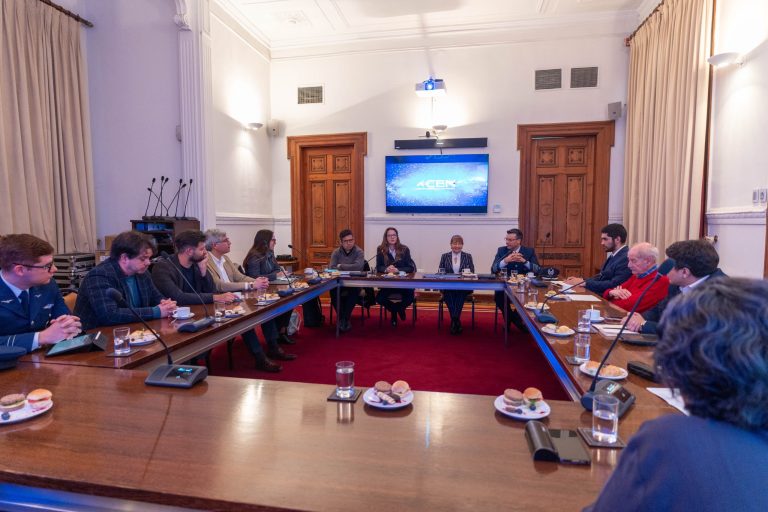
The Minister of Science, Technology, Knowledge and Innovation, Dr. Flavio Salazar, visited on Wednesday the Center for the Development of Nanoscience and Nanotechnology of Chile, CEDENNA, located at Universidad de Santiago de Chile, where researchers welcomed him with a fair of nanotechnology innovations with direct applications in different productive sectors.
Accompanied by the center’s director, National Science Prize winner Dr. Dora Altbir, he toured the different modules, talking with the scientists who explained the projects in detail, including nanotechnology sensors to detect uncrushables and machinery wear in mining; nanotechnology sensors to detect pathogens such as Listeria and E. coli in food; and smart packaging to preserve food over time and maintain its quality, among others.
OPEN LAB
On the occasion, Dr. Altbir announced that CEDENNA is developing a new strategic science-industry platform called OPEN LAB, through which it seeks to create a hub of partner companies to promote research and technological development in search of innovative answers to the challenges of each sector.
After touring the different stands, Flavio Salazar visited two of CEDENNA’s laboratories, Biology and Nanosafety, the only one of its kind in the country.
The Minister highlighted that CEDENNA’s approach is fully in tune with the strategy set out by the government and his ministry to promote research development, “truly putting science in its rightful place within a development model.”
“The vocation and approach of the Center for the Development of Nanoscience and Nanotechnology has a lot in common with what we want to promote for science in Chile: scientific excellence and the training of human resources and talent, focused on projects related to the country’s development,” he noted.
SCIENCE FOR A NEW DEVELOPMENT MODEL
The Minister concluded his tour at CEDENNA’s Auditorium, meeting with the Center’s researchers, technicians and professionals, to whom he detailed the program “Science for a new development model”, built on four objectives: strengthening the STKI system; promoting the decentralization of research and innovation focused on sustainable development; driving towards national sovereignty in scientific and technological capabilities in strategic areas; and democratizing knowledge by linking scientific and technological research with social development, promoting sustainability and involving society and its territories.
He highlighted that the exploratory budget foresees a significant increase in the Ministry of STKI’s funds for 2023 and explained how the Tax Reform proposed by the Executive can positively impact the sector.
In her speech, CEDENNA’s director, Dr. Dora Altbir Drullinsky, highlighted that “in these 12 years, the effort made by each of CEDENNA’s researchers has been considerable. Thanks to their work, and that of hundreds of students, postdocs and engineers who take part in our Center each year, we have become the largest nanoscience and nanotechnology Center in the country.”
“I trust that the committed, excellent work we do, as well as that of other research centers in the country, will capture the attention of the private sector and convince it to support and invest in national science and its developments. The future is nanometers away and Chile cannot and must not fall behind,” she said.
“I am convinced,” she added, “that this is the way we can follow a path in which cooperation, collaboration, inter- and multidisciplinary and inter- and multi-university perspectives are key, in joint public-private work.”
The chair of CEDENNA’s board and rector of Universidad de Santiago, Juan Manuel Zolezzi, highlighted that the Ministry of Science’s approach is on the right track. “The proposals he has made are heading in a direction that will be good for science and the country,” he noted.
“Various countries have interpreted the potential of nanoscience and nanotechnology very well, both out of scientific interest and because of the great economic impact nanotechnology will generate on the world stage, placing the countries that develop it in a favorable position and therefore able to generate sustainable public policies, creating a virtuous circle between science, technology, the economy and public policy. We trust that Chile will also follow that path for the sake of development, equity, growth and the good of the country,” said the USACH rector.
The event concluded with the presentation to the minister of a winning photograph from one of CEDENNA’s contests, called nano gears, vanadium oxide nanostructures in a beautiful, symmetrical assembly, as a symbol of “a trace of the nanoworld”.