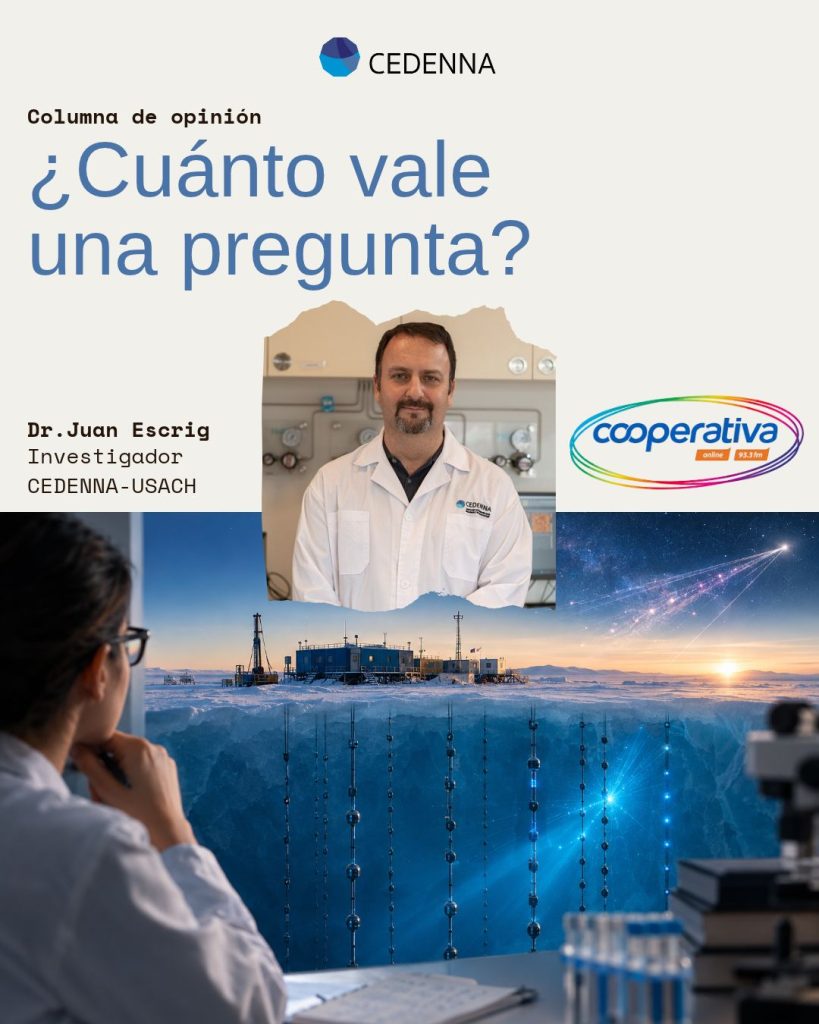
In his column titled “How Much Is a Question Worth?”, Dr. Juan Escrig Muría addresses the challenges of scientific funding in Chile and highlights the importance of sustaining research, infrastructure, and human capital to drive tomorrow’s discoveries.
Dr. Juan Escrig Muría, a researcher at the Center for Nanoscience and Nanotechnology (CEDENNA) and a professor at the University of Santiago de Chile (USACH), published an opinion column in Radio Cooperativa titled “How Much Is a Question Worth?”, in which he reflects on the value of scientific research and the need to sustainably invest in the capabilities that generate new knowledge.
Drawing on the experience of the IceCube Neutrino Observatory in Antarctica, the researcher examines how major scientific discoveries are the result of decades of work, experimentation, technological development, and investment, the outcomes of which cannot always be anticipated.
In his column, Escrig links this international experience to the budget discussion Chile currently faces regarding science, technology, knowledge, and innovation, paying particular attention to the importance of maintaining and strengthening scientific infrastructure, specialized equipment, and the training of human capital.
The academic warns that building research capabilities can take years or even decades, while weakening them can happen in a considerably shorter period. In this regard, he emphasizes that scientific development requires continuity, planning, and a long-term outlook that goes beyond budget cycles.
The reflection invites us to consider not only the immediate results of investment in science, but also the opportunities it creates for future generations to address challenges and answer questions we are not yet able to imagine today.
As the researcher states in his column: “Budgets are written for a year, but science is built over generations.”