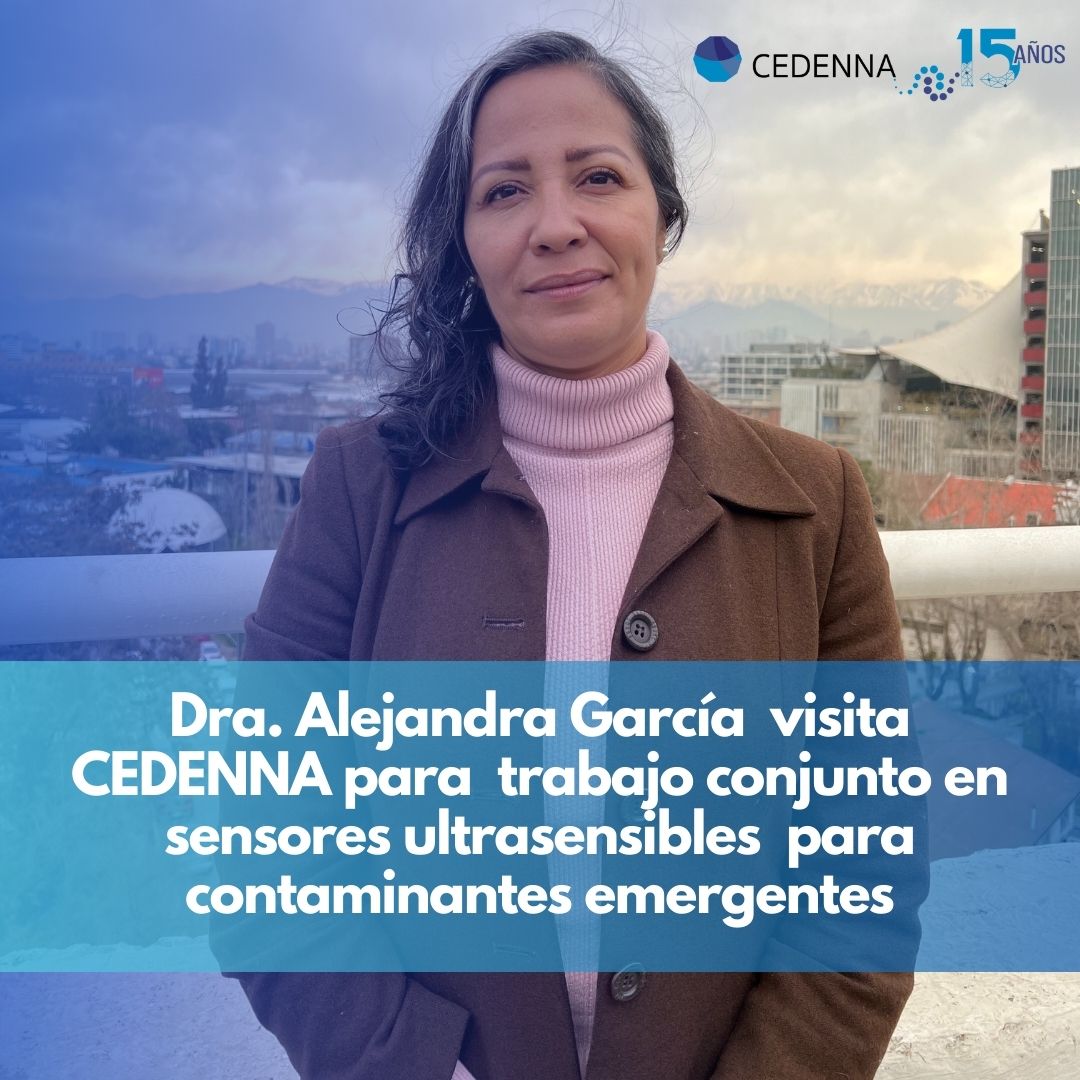



Dr. Alejandra García García, senior researcher at Mexico’s Center for Research in Advanced Materials (CIMAV), will be carrying out activities and working sessions at the Center for Nanoscience and Nanotechnology (CEDENNA) until August 11. The aim is to share experiences and advances in the modification of nanomaterials that can be used to detect emerging contaminants, raise awareness and contribute to the development of regulations.
The Mexican scientist is currently working on modifying the properties of materials such as carbon nanotubes, graphene and reduced graphene oxide using doping techniques. These modifications alter the electronic structure of the materials, making them richer in electrons and useful for very sensitive detection of emerging contaminants, a growing concern for the future.
Precisely to keep advancing her work, she needs to know what is happening at the atomic level: “how the detectors and sensors work… which atoms are binding to which atoms of the sensor so they can be identified, for example”. There are no experimental tools to answer these questions, which is why working through simulations is key. That is where CEDENNA comes in, through a group of theoretical researchers specializing in this area.
This joint work is very relevant in a global scenario increasingly affected by pollution. “Our research can contribute above all to raising awareness and trying to promote the establishment of rules that do not exist today. For example, there are no regulations for emerging contaminants,” she says with concern.
She notes that countries such as India and China face bigger problems, while nations like Mexico and Chile are not yet at that level, but may head there, especially if there are no regulations or public policies bringing science and the State together.
One of the emerging contaminants the researchers are studying is PFAS, which stands for per- and polyfluoroalkyl substances and covers a family of chemical compounds widely used in various industries due to their unique water-, oil- and heat-resistant properties. These compounds are commonly found in everyday products such as non-stick cookware, Teflon, food packaging, stain-resistant textiles and firefighting foams. However, their persistence in the environment and potential adverse effects on human health have raised concern and drawn the attention of regulators worldwide.
“I don’t know if you heard recently that they tried to take Teflon off the market. That is a type of PFAS. However, there are thousands of PFAS and we live with them every day. The United States issued an alert and last year said it did not want any more PFAS: but of course, the contamination is already there. So that is precisely where the importance of demonstrating the damage, raising awareness in time, establishing rules and forcing industries to reduce this type of pollution comes in”.
“That is why it is essential to create much more sensitive sensors that detect lower levels to raise alerts and demonstrate at the nanomolar, centimolar level, etc. We have to lower the levels as much as possible, and that is the work we are doing,” she explains.
A frontier collaboration
Dr. Samuel Baltazar, researcher in CEDENNA’s Magnetic Nanostructures Line, highlights the importance of these international collaborations. He explains that “these interactions not only allow us to share resources and knowledge, but also enrich perspectives and solutions to common problems”.
The researcher highlights that CEDENNA is permanently focused on building international networks in scientific research, since sharing research and experiences with experts from other countries enriches projects and opens new opportunities for innovation.
This collaboration between CIMAV and CEDENNA promises to provide innovative and effective solutions to urgent environmental problems, highlighting the crucial role of science and international cooperation in moving towards a more sustainable future.