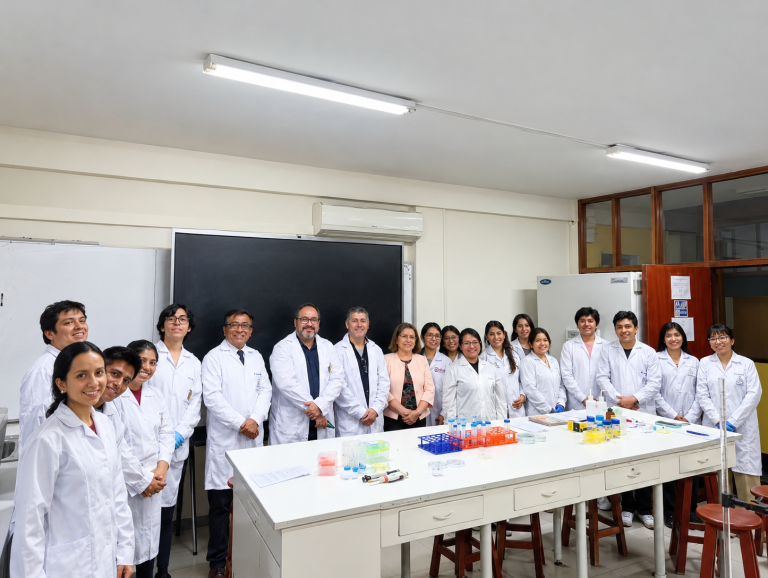



- In addition to receiving theoretical classes from leading researchers, including two National Prize for Exact Sciences winners, the teachers had the opportunity to take part in hands-on experiments, even making their own nanoparticles, guided by expert scientists in areas such as nanomedicine, nanomagnetism, nanobiotechnology, nanosafety and the development of materials with nanotechnology.
The ninth edition of ProNano, the most significant event in nanoscience and nanotechnology for Chilean teachers, was held on Thursday, March 14, at the Eduardo Morales Santos Research Centers Building of the Universidad de Santiago de Chile (USACH). Organized by the Center for Nanoscience and Nanotechnology (CEDENNA), this event, unique in the country, offers educators an intensive day of learning, covering both theory and practice in the cutting-edge field of nanotechnology.
ProNano is an initiative that the Center for Nanoscience and Nanotechnology, CEDENNA, has held periodically since 2010, as part of its social responsibility towards the education of new generations. On this occasion, the PRONANO workshop was held in partnership with the EXPLORA program and the Chilean Network of Chemistry Teachers.
In his welcoming remarks, the executive director of the CEDENNA Center, Dr. Juan Escrig –—explaining the dimensions of the nanometric materials attendees would work with throughout the day— recalled that The Little Prince had already warned us that “what is essential is invisible to the eye”. He stressed that the Center’s members firmly believe in the transformative power of science in the country. “With this workshop we not only want to update your knowledge, but also show you how these new technologies are addressing critical issues in health, the environment, energy and production technology. And in that way be a bridge between science and society,” he concluded, stressing that CEDENNA hopes to maintain a permanent alliance with the country’s teachers.
“This workshop is not simply an event; it is a tangible testament to our commitment to education and the dissemination of scientific knowledge. It provides a unique platform for people from education and science, promoting an enriching exchange of ideas and fostering a new generation of researchers who may emerge from school classrooms across the country,” highlighted Dr. Escrig.
The opening ceremony was also attended by the director of the Ministry of Education’s Innovation Center, Martín Cáceres Murrie (on behalf of the Minister of Education); the head of the Educational Communities Department of the Science and Society Division of the Ministry of Science, Technology, Knowledge and Innovation, Marisol Gómez Arancibia, and the Vice-Rector for Academic Affairs of the Universidad de Santiago, Patricia Pallavicini. The teachers were welcomed by the executive director of the CEDENNA Center, Dr. Juan Escrig Murúa, and the executive director of the CEDENNA Foundation and National Prize for Exact Sciences winner, Dr. Dora Altbir Drullinsky.
This new edition, following the success of previous ones, responds to the growing demand for specialized knowledge among teachers, especially those who teach 11th and 12th grade students, in line with the new Science curriculum for secondary education. ProNano 2024 aims to empower educators with critical tools and knowledge, allowing them to integrate nanoscience and nanotechnology concepts into their teaching strategies.
The Ministry of Education representative, Martín Cáceres, highlighted CEDENNA’s various outreach initiatives and the importance the Ministry gives to pedagogical innovation, especially associated with local problems in the different regions.
Meanwhile, the Ministry of Science representative, Marisol Gómez, expressed her satisfaction with this alliance of more than five years with CEDENNA and with the presence of Explora teachers at the workshop. She said she has personally had the experience of taking part in these workshops and stressed the importance of “spreading this to every corner of our country, in support of our teachers and for the benefit of science and teaching”.
During this intensive day, the teachers attended talks by nine researchers, including National Prize winners Miguel Kiwi and Dora Altbir, and in the afternoon visited laboratories for electron microscopy, nanomagnetism, nanosafety, nanobiomedicine, plant nanobiotechnology and smart packaging with nanoparticles, among others, carrying out their own guided experiments in each of them. In the nanobiomedicine laboratory, together with Dr. Patricia Díaz, they made albumin nanoparticles using egg whites and ethanol.
“This powerful experience will allow us to replicate the wonder we experienced today among our colleagues and our students. And significantly improve the teaching approach we offer to meet the 11th and 12th grade curriculum,” said some of the participants at the end of the workshop.