


With the attendance of teachers from different regions of the country, the Center for Nanoscience and Nanotechnology, CEDENNA, held the tenth edition of “ProNano”, the nanoscience and nanotechnology refresher workshop that allows teachers to approach the new secondary school curriculum with the most up-to-date knowledge.
Attendees were welcomed by the USACH Vice-Rector for Research, Innovation and Creation, Dr. Alberto Monsalve; the Director of CEDENNA, Dr. Juliano Casagrande and the Executive Director of the CEDENNA Foundation, Dr. Dora Altbir, joined by the Head of the Science and Society Division of the Ministry of Science, Pablo Brugnoli, on behalf of the government.
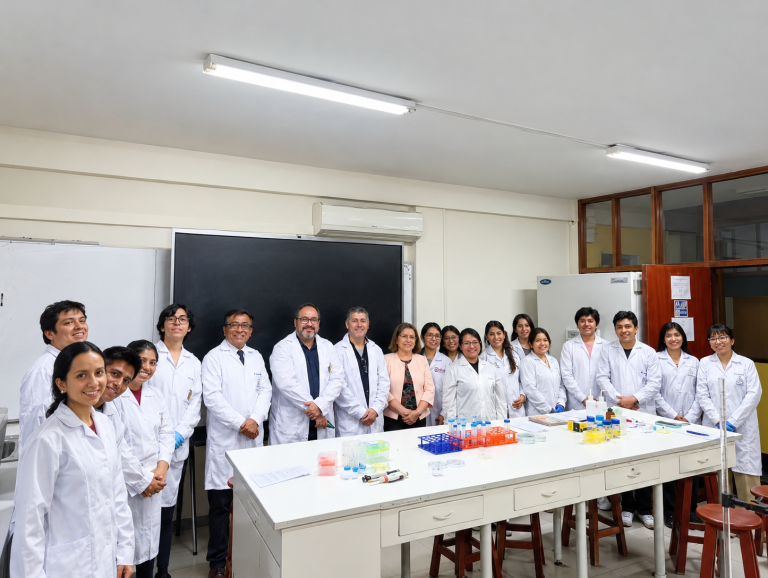
This year ProNano was organized in partnership with the Explora Program, the Chemistry Teachers Network and SLEP Santa Corina, as well as Corporación Aprender and the USACH Strategic Engagement Department. During the session, teachers had the opportunity to attend talks by leading researchers, carry out hands-on experiments and visit high-end laboratories, while doing their own experiments so they can take these experiences and knowledge into their classrooms.
“Our mission is to generate frontier knowledge, develop technological innovations and train excellent human capital in the field of nanoscience and nanotechnology,” stressed Casagrande. He emphasized that for this to happen “it is essential that the knowledge generated in our laboratories goes beyond them and reaches society. In this sense, education plays a crucial role”.
Vice-Rector Alberto Monsalve said that “CEDENNA’s work is not limited to excellent research; it also has a strong commitment to education and science outreach. Programs like ProNano are an example of this, providing teachers with up-to-date tools and knowledge so they can pass on to their students the wonders and applications of nanoscience”.
Meanwhile, Pablo Brugnoli highlighted CEDENNA’s role “in bringing frontier technology to teachers so they can pass it on in the classroom to Chile’s students. We find this very relevant because precisely one of the objectives of our Science and Society Division, of the Explora program, is to democratize science, democratize knowledge and bring science closer to people”.
“At the Science and Society Division of the Ministry of Science, we have been working hard for science that is neither foreign nor distant. Science that is lived, talked about and practiced in the territories. And that begins here, with you, teachers, who hold in your hands the noblest and most transformative task: sparking curiosity, opening worlds, building critical awareness and hope at the same time,” he said.
He added that “nanoscience may seem distant or abstract to those unfamiliar with it. But you are here to prove otherwise: that it is possible to take this frontier knowledge into classrooms, translate it into teaching experiences and turn it into opportunities for children and young people across Chile to approach science not only as content, but as a way of looking at the world”.
ProNano was born in 2010 with the aim of being a bridge between cutting-edge research and school education. This is because, for CEDENNA, teachers are the main agents of change in training new generations of researchers and professionals in this and other fields of the country’s development.
Albumin nanoparticles
The session featured a unique scientific experience that can be replicated in the classroom: secondary school teachers from different regions of the country took part in making albumin nanoparticles using egg whites.
“This is an activity that teachers will be able to replicate directly in their classrooms, using everyday, accessible materials. Through a simple process, they will transform an egg white into a tangible example of frontier science,” explained Dr. Patricia Díaz, CEDENNA researcher in charge of the hands-on experience.
Dr. Díaz explained that ovalbumin nanoparticles —the protein mostly present in egg whites— are similar to the human albumin nanoparticles produced today and constitute an advanced drug delivery system, widely researched in the field of nanomedicine.
“These particles are biodegradable and safe, and are currently used in cancer treatments for controlled drug release and in bone marrow scintigraphy, lymphoscintigraphy and sentinel lymph node localization studies in patients with malignant melanoma and breast cancer. Since ovalbumin nanoparticles are edible, they can be useful in the food industry,” she concluded.
ProNano is a pioneering initiative in Latin America and has become a benchmark in training secondary school teachers, providing them with innovative tools to enrich their lessons. In this tenth edition, the workshop includes talks by leading scientists (including National Prize for Exact Sciences winner Dora Altbir), visits to specialized laboratories and hands-on activities designed to strengthen understanding of key principles in nanoscience, as well as experiences they can carry out in their classrooms.
In the words of the organizers, this 2025 edition is aligned with the new Science curriculum for secondary education, responding to the growing need for specialized knowledge in schools. Its goal is to empower teachers with methodologies and experiences that allow them to incorporate nanoscience and nanotechnology concepts into their teaching practices in a meaningful and applicable way.