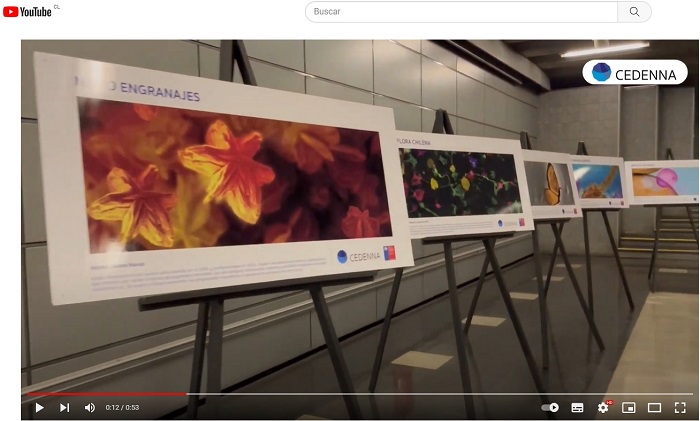
From Monday, May 15 to Friday, May 27, CEDENNA’s exhibition “Images of the Nanoworld” will be installed on the esplanade of the Bellas Artes Metro Station so that people of all ages can visit it and discover, through playful and beautiful images, the amazing world of nanoscience and nanotechnology.
The exhibition generated great interest during its stay at the Planetarium, where children and adults approached nanoparticles from a playful perspective that sparked their curiosity and interest in this science, so present in everyday life through technological developments that help provide solutions in health, the environment, agriculture, medicine and food packaging, among others.
“Behind this beauty in the nanouniverse there are many practical things, since each of these particles has a specific use, for example to remove arsenic from water, to improve the quality of food packaging, to absorb oxygen so that food does not oxidize and lasts longer, in a mining sensor or to detect pathogens in food,” says CEDENNA’s director, Dr. Dora Altbir, 2019 National Prize in Exact Sciences.
“We want to show that this world is tremendously useful and important for development, but also infinitely beautiful,” she stresses.
Each of the 12 photographs in the exhibition was captured by CEDENNA researchers and students using various techniques and electron microscopy. For example, a springtime butterfly flying among pollen grains turns out to be a porous hydrogel containing cellulose nanofibrils used to remediate colored water.
A beautiful pink jellyfish among apparent underwater rocks is not what it seems. It is titanium dioxide (TiO2), which in its most common phase is known as rutile, with interesting optical properties described centuries ago. Another photograph shows an aggregate of vanadium oxide tubes in different oxidation states (V(5+) and V(4+)). The resemblance to coral is striking.
Each image is accompanied by a scientific description showing what is really behind each photograph.
After touring several educational and cultural centers in the Metropolitan Region, the exhibition will begin its journey from Arica to Punta Arenas.