



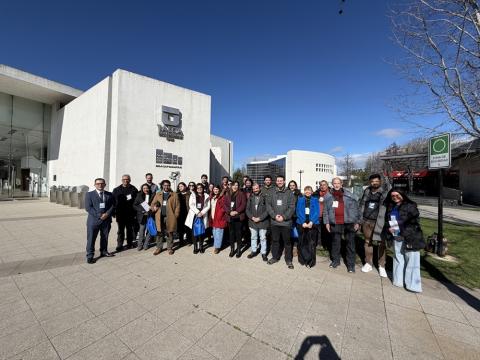
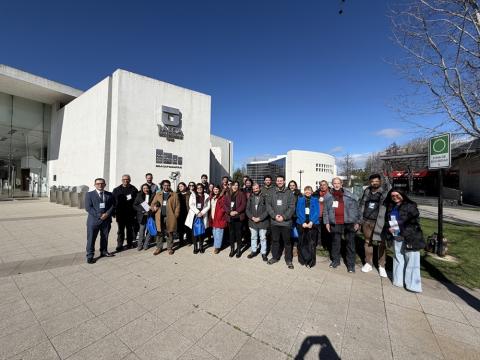
The first regional edition of the teacher training program brought together teachers from different municipalities at the Universidad de Talca, along with two National Prize for Exact Sciences winners and CEDENNA researchers. The session combined lectures, laboratory work and teaching resources to strengthen the teaching of nanotechnology in classrooms.
After ten editions held in the Metropolitan Region, CEDENNA’s ProNano program began a new stage with its first regional session. The activity took place on Thursday, July 30, at the Universidad de Talca and brought together 19 science teachers from schools in different municipalities of the Maule Region.
The free refresher session was organized by the Center for Nanoscience and Nanotechnology, CEDENNA, together with the Universidad de Talca and the Universidad Católica del Maule, with the aim of bringing advances in nanoscience closer to those responsible for passing on this knowledge to new generations.
The program brought together Dr. Dora Altbir, director of CEDENNA and 2019 National Prize for Exact Sciences winner; Dr. Miguel Kiwi, 2007 National Prize for Exact Sciences winner; Dr. Cristian Vilos, CEDENNA researcher and dean of the Faculty of Medicine of the Universidad de Talca; and Dr. Samuel Baltazar, CEDENNA researcher and Universidad de Santiago de Chile academic.
Through the lectures, the teachers learned fundamental concepts of nanoscience and quantum mechanics, along with applications of nanotechnology in medicine, agriculture, animal health and new materials. The session also addressed strategies for teaching this content through approachable, hands-on experiences adaptable to the school setting.
The opening ceremony was led by the rector of the Universidad de Talca, Dr. Arcadio Cerda Urrutia, together with the Regional Ministerial Secretary of Education of the Maule Region, Cristian Letelier.
“Nanotechnology and nanoscience are highly important topics because of the contributions they can make to productive development, income generation, resource savings and also job creation,” said Rector Arcadio Cerda.
The director of CEDENNA explained that holding ProNano in Maule responds to the aim of expanding the program’s territorial reach and making it easier for teachers in the regions to access scientific training. “After ten editions in Santiago, we felt it was time to take ProNano directly to the regions. We want more and more teachers to have access to knowledge, experiences and tools that they can then share with their students. Science must reach every territory, and that link begins in the classroom,” said Dr. Dora Altbir.
Nanomedicine and experiences to take to the classroom
Nanotechnology is part of the secondary school science curriculum. For this reason, ProNano Maule was not limited to lectures, but included hands-on activities specially designed so that participants could later adapt the experiences to their schools.
In the afternoon, the teachers toured laboratories at the Universidad de Talca and took part in the “Nanomedicine in the classroom” workshop, led by Dr. Cristian Vilos and the team of the Center for Nanomedicine, Diagnostics and Drug Development, ND³.
In this activity they synthesized ovalbumin nanoparticles with curcumin and used the Tyndall effect to observe the behavior of a colloidal system. The experience made it possible to work on scientific concepts using materials and procedures that can be used for teaching purposes.
The session concluded with a workshop led by Dr. Samuel Baltazar, aimed at providing strategies to teach nanotechnology and explain phenomena that occur at scales that are difficult to observe directly.
Each participant received a teaching kit that included protocols, guides for teachers and students, a safety data sheet, activities and assessment material. These resources will allow the experiences developed during ProNano to be replicated and adapted in school communities.
ProNano Maule marks the beginning of the program’s territorial expansion. CEDENNA plans to continue this experience in the Valparaíso and Antofagasta regions, expanding teacher training opportunities and the link between scientific research and the country’s educational communities.


