



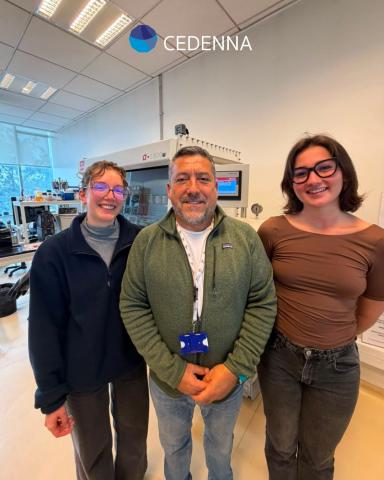
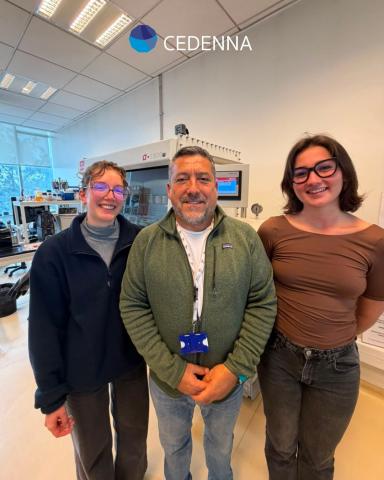
The students’ stay strengthens scientific collaboration between Chile and France and highlights the capabilities of CEDENNA and the Universidad de Santiago de Chile in training, research and access to specialized equipment.
Students Camille Chabanne and Camille Lerayer traveled from the French city of Rennes to Santiago to complete a four-month research internship at CEDENNA’s Nanostructure Chemistry Laboratory and the Laboratory of Molecular Magnetism and Molecular Materials (LM4), directed by Dr. Diego Venegas-Yazigi, CEDENNA researcher and Universidad de Santiago de Chile academic.
Both study at the École Nationale Supérieure de Chimie de Rennes (ENSCR), a French institution specializing in chemistry training. Their stay in Chile was part of the practical experiences they must complete during their three years of training, including an internship outside their institution and another linked to the industrial sector.
Although they could have chosen closer destinations, the students decided to travel to South America and carry out this stage of their training in Chile. “We could choose other countries, but we decided to come to South America. Being here was a choice and also meant living an experience far from home,” they explained. During their time at CEDENNA, the students were able to continue work begun in France, taking advantage of equipment and facilities similar to those they use at their home institution. This continuity made it easier for them to join the laboratory’s experimental activities and develop their research. According to them, one of the first surprises was finding that the working conditions and capabilities available in Chile were comparable to those at their school in France.
“Before coming we didn’t know exactly what we would find, but the work is quite similar. There is a lot of equipment and we have been able to continue here what we started in France,” said Camille Chabanne. The students also highlighted the team’s approachability and its members’ willingness to communicate with them, despite language differences. “The first difference is the language, of course, but people speak English and make an effort to communicate with us. That has allowed us to integrate and work very well,” said Camille Lerayer.


