



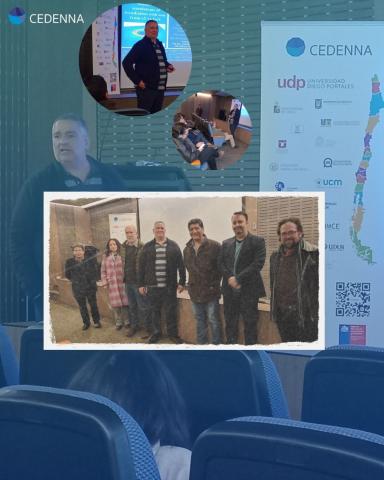
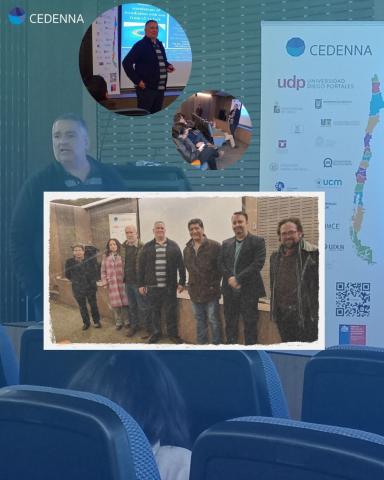
The second session of the 2026 CEDENNA Seminar Series brought together 23 people from seven universities, CEDENNA and the private sector. The Argentine researcher explained how computer simulations make it possible to study the transformations materials undergo when impacted by ions.
On Wednesday, July 29, CEDENNA held the second session of its 2026 Seminar Series, with the participation of Dr. Eduardo Bringa, researcher at the National Scientific and Technical Research Council (CONICET) and the Universidad de Mendoza, Argentina.
The activity was held in person in the Auditorium of the Research Centers Building of the Universidad de Santiago de Chile, and was also streamed online. During the talk “Atomistic simulations of ion irradiation, from eV to GeV”, Dr. Bringa explained how computational tools make it possible to analyze what happens in the structure of a material when it is subjected to the impact of ions with different energy levels.
These simulations make it possible to study processes that occur at spatial and temporal scales that are difficult to observe directly through experiments. Using computer models, it is possible to examine the changes, damage and transformations that occur in materials and anticipate their behavior under different irradiation conditions.
The researcher presented examples related to materials physics, nanotechnology, semiconductors and nuclear and space technologies, fields in which knowing how materials respond to radiation is necessary to assess their resistance, stability and performance.
The session created a space for exchange between the speaker and participants, who were able to delve into the possibilities and limitations of atomistic simulations and their contribution to the study of materials at the atomic scale.
The CEDENNA Seminar Series seeks to bring different areas of nanoscience and nanotechnology closer to students, researchers and academics, as well as to promote the exchange of knowledge with national and international specialists.


