



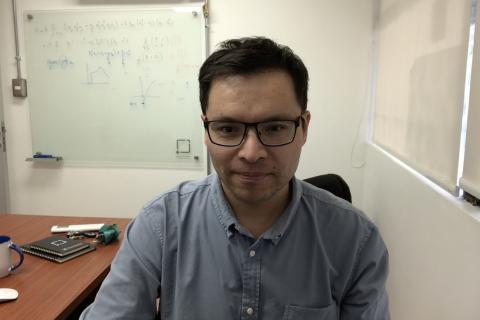
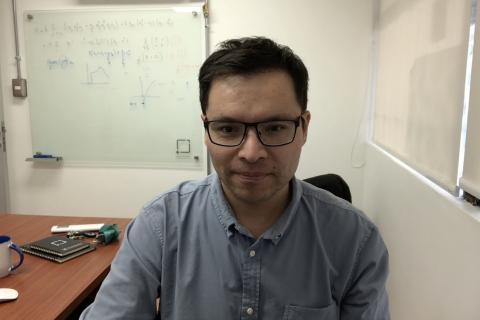
Dr. Guillermo Romero Huenchuñir, CEDENNA researcher and academic at the Department of Physics of the Universidad de Santiago, will visit Canada in August to attend an International Conference and meet with Prof. Adrian Lupascu, an expert at the University of Waterloo and the Institute for Quantum Computing (IQC), a world-leading research center that currently brings together more than 350 researchers to develop quantum computing, sensing and materials technologies.
“During the research visit to Professor Lupascu’s laboratory we will seek the opportunity to collaborate with them on the control of superconducting quantum circuits, trying to establish a direct line of collaboration by systematically proposing ideas that can be implemented with this technology, in order to position the QUTE group (https://qute.group/) USACH CEDENNA,” explains Dr. Romero. “It is one thing to talk and propose ideas grounded in experimental implementations; it is much better to discuss ideas with experts who work in the laboratory and can tell you what is possible to implement and what is not,” says Dr. Romero.
Meanwhile, at the conference “Conference on Quantum Information and Quantum Control (CQIQC-XI)” to be held at the Fields Institute, Toronto, “we will present a poster titled ‘Equally entangled multiqubit states’ and we will have the opportunity to attend the tribute to three world-renowned researchers in the field of quantum mechanics”.
Quantum physics is not just theory: its principles are behind technologies we already use every day, such as the transistor and the laser. This is known as the ‘first quantum revolution’. Today, technological advances allow us to go further: we can control delicate quantum properties, such as coherence, which were previously too fragile to manipulate. This is giving rise to a new generation of quantum technologies, such as quantum computing, quantum sensing and quantum cryptography, which make up what is known as the ‘second quantum revolution’. We have yet to explore everything this second revolution will bring,” he concludes enthusiastically.


