Image description:
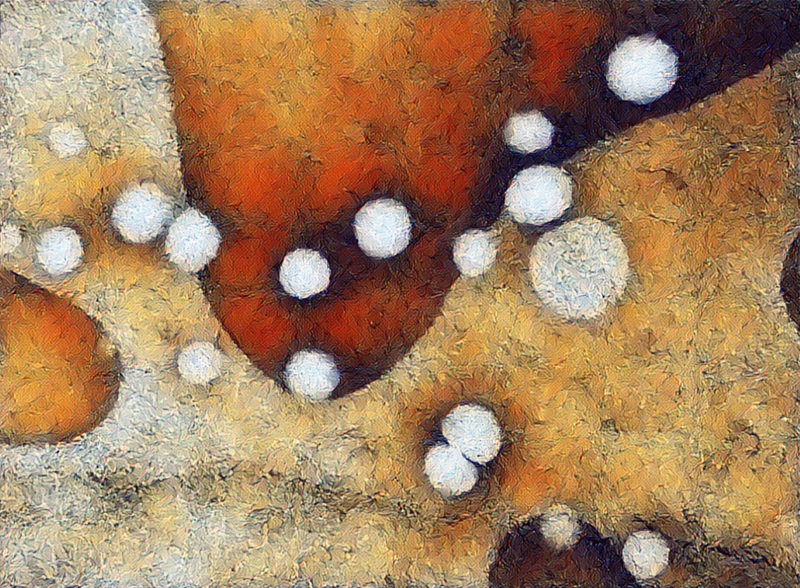
This image, which you discovered in the calendar for March and April, shows lipid nanoparticles, spherical nanoscale structures used to carry active compounds such as resveratrol and enable their controlled release. It was obtained by transmission electron microscopy, a technique that makes it possible to observe materials invisible to the human eye. Their shape and arrangement reminded the authors of the strokes of rock art, reminding us that curiosity to understand and represent the world has always been part of humanity.
Authors: Drs. Patricia Díaz and Pedro Chana.
TEACHING ACTIVITY
Suggested level:
7th grade to 10th grade (2° medio)
Subject:
Natural Sciences / Visual Arts (can be integrated)
Learning Objectives (Chilean curriculum)
- Natural Sciences, 7th grade:
Observe and describe natural phenomena using images and models. - Natural Sciences, 9th–10th grade:
Analyze how science uses models and images to represent phenomena that cannot be observed directly.
Key concepts
Nanoscience · Scale · Pattern · Scientific observation · Analogy
Invisible patterns, visible stories
Students observe the image and describe the shapes, colors or patterns they recognize. The teacher then explains that it is an image obtained at the nanometric scale using electron microscopy.
In groups, they compare the image with familiar artistic expressions (rock art, textiles, urban designs) and reflect on how patterns repeat in nature and culture.
Questions for reflection
- Why do certain shapes seem familiar to us?
- Can a scientific image also be a form of art?
- What does science allow us to see that we cannot see with the naked eye?
:::::::::::::::::::::::::::::::::::::::::::::::::::::::::::::::::::::::::::::::::::::::::::::::::::::::::::::::::::::::::::::::::::::::::::::::::::::::::::::::::::::::::::::::::::::::::::::::::::::::::::::::::::::::::::::::::::::::::::::::::::::::
Below we invite you to watch the video in which Dr. Pedro Chana tells us about his image “Rock Art”