
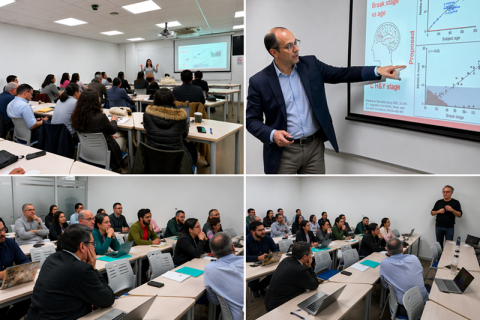
Intense dialogues took place between physicians and researchers during the scientific discussion on Parkinson's disease, sponsored by CEDENNA and organized by the Postgraduate and Continuing Education Department of the Faculty of Medical Sciences at the University of Santiago (Usach).
According to the moderator of the meeting and CEDENNA researcher, Dr. Pedro Chaná, director of the CEDENNA-Usach Center program and of CETRAM (Center for the Study of Movement Disorders), the objective was "to bring together scientists with different perspectives and create a space for creative dialogue, where the knowledge that each person contributes is challenged to build an integrated view that guides progress in this field." Participants included Dr. Alberto Espay, a neurologist from the University of Cincinnati, and researchers from Universidad Mayor, Dr. Natalia Salvadores and Dr. René Vidal.
In a context of an aging population, the need to advance in the diagnosis and understanding of diseases such as Parkinson's and Alzheimer's is becoming increasingly urgent. “We cannot ignore that age is a major factor in this process. However, the main medical problem is that we are diagnosing patients too late. The challenge is to understand the causes and be able to anticipate them as much as possible, ensuring that the findings are causal and not merely incidental,” Chaná emphasized.
For his part, Dr. Espay stressed that knowing the advances made in high-end laboratories is fundamental but is not, in itself, the goal of the participants. “Research is a platform to help patients. Bringing together physicians and researchers from different specialties allows us to define what kind of research we need to have a more effective impact on those living with Parkinson's or Alzheimer's. The knowledge generated in cutting-edge laboratories must be translated into concrete tools for diagnosis and treatment,” he noted.
- Log in to post comments