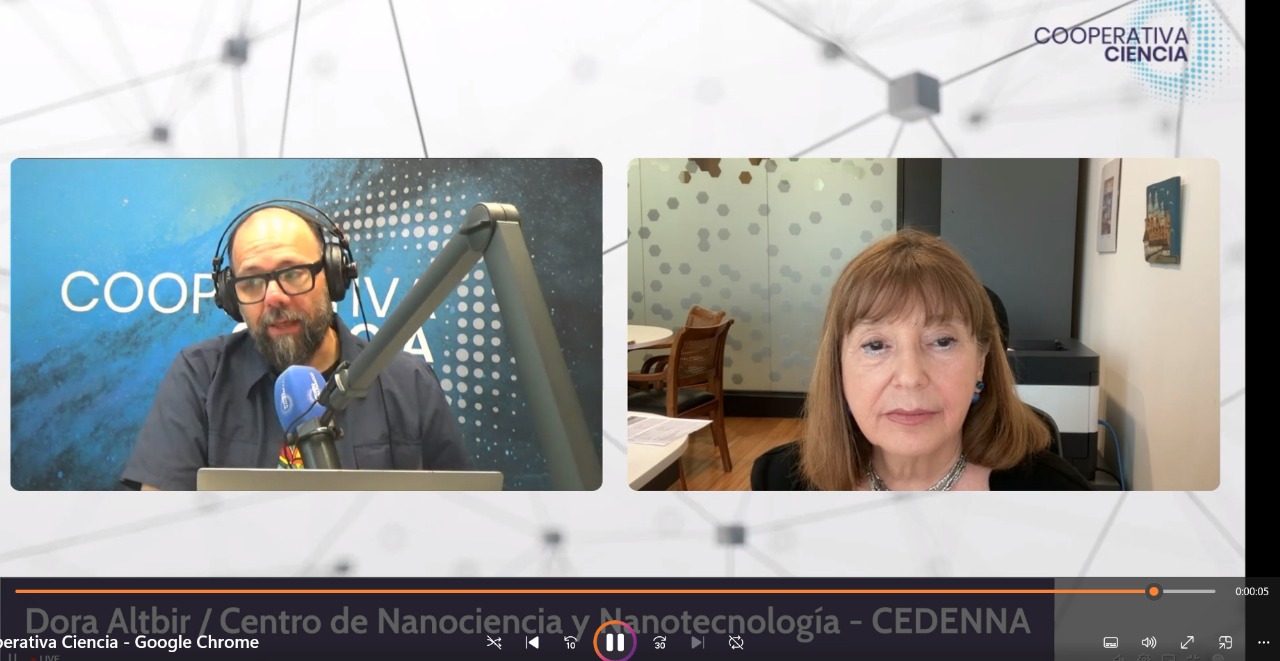

The director of the Center for Nanoscience and Nanotechnology (CEDENNA), Dr. Dora Altbir, participated in the program Sin Gravedad of Cooperativa Ciencia, hosted by Jorge Lira, where she addressed the main challenges and opportunities of the new institutional period after the awarding of the ANID 2025 national competition for Applied Research Centers.
During the conversation, the National Prize winner for Exact Sciences highlighted that this new stage will allow the consolidation of key developments in applied nanotechnology, with direct impacts on health, environment, industry and energy, among others, thanks to the multidisciplinary work of the Center, which integrates researchers from physics, chemistry, biology, medicine and engineering.
One key point highlighted by Altbir was the potential of nanoparticles and nanomaterials to address environmental challenges. In areas such as remediation, contaminant detection, and the design of eco-friendly materials, the Center is driving new approaches that combine cutting-edge science with technological application.
The collaborative work of interdisciplinary teams allows progress in solutions that connect directly with the needs of the country: better tools for agriculture, more efficient treatment systems and developments geared towards a sustainable environment.
In the area of health and biomedicine, he explained that we are making progress in developments that can transform how we treat complex diseases. One of these is a formulation based on magnetic nanoparticles for hyperthermia, a technique that allows us to destroy cancer cells by applying highly localized heat. Initial results in cervical cancer show a significant decrease in tumor viability, opening a real door to safer, less invasive therapies with less impact on healthy tissue.
We are also working on an innovative solution for blindness caused by corneal damage, using a technique that allows us to cultivate the patient's own oral epithelial cells to regenerate the cornea. This approach, based on the use of biomaterials and nanotechnology, represents a high-potential alternative for people who lack effective treatment options, and promises to substantially improve the success rates of current treatments.
In addition, an electrochemical biosensor has been developed that can detect biomarkers associated with neurodegenerative diseases such as Alzheimer's and Parkinson's in their early stages. Using electrodes functionalized with nanoparticles and nanoantibodies, this device aims to provide early and personalized diagnoses, which is crucial in conditions whose progression can be modified with timely intervention. These types of technological tools, based on nanotechnology, can have a direct impact on public health and people's quality of life.
A scientific training ecosystem that is already impacting Chile
Throughout its 15 years of existence, CEDENNA has trained more than 900 undergraduate and postgraduate students, and more than 150 PhDs who today lead lines of research in universities and national institutions.
Many of them develop theses and projects directly in strategic areas of nanotechnology, which has allowed the consolidation of a growing community of young researchers committed to applied science and innovation.
International perspective and projection to the future
When asked about Chile's position in global nanoscience, the director noted that, although countries like the US, South Korea, Japan, and Israel have been investing in this area for decades, Chile's contribution is significant. "The number of scientists in nanoscience has grown tremendously in recent years, and the opportunities ahead are enormous. CEDENNA will consolidate developments in health, energy, industry, and the environment, surprising us with new applications," she stated.
Finally, Altbir emphasized the need for science to occupy a more prominent place in discussions about the country's future: “Science is a possible path to development and greater well-being. To achieve the Chile we want, we need it to be on the agenda and have the necessary resources.”