
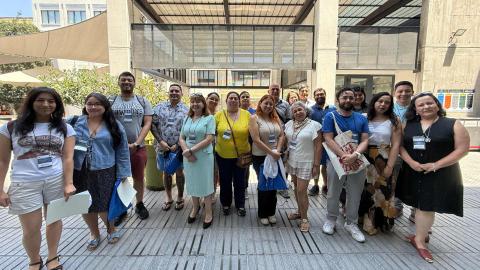
On Saturday, January 17, the Center for Nanoscience and Nanotechnology, CEDENNA, held the II Hybrid Meeting of Training in Nanoscience and Nanotechnology for Chemistry Teachers, an event that brought together teachers from different regions of the country with the purpose of strengthening the teaching of sciences by incorporating cutting-edge content, aligned with the learning objectives of the national curriculum.
The activity was developed in a hybrid format, combining face-to-face participation and remote connection, and was conceived as a meeting space between the scientific community and the teaching community, aimed at providing conceptual and pedagogical tools that allow the integration of nanoscience and nanotechnology in the classroom in a relevant, didactic and contextualized manner.
Following the welcome address by the director of CEDENNA, Dr. Dora Altbir, researchers from CEDENNA addressed theoretical foundations, practical applications and current challenges of nanotechnology, with special emphasis on its transfer to the school environment and its link with strategic areas for the development of the country.
The program included the following presentations:
-
Fundamentals of Nanoscience and Nanotechnology, presented by Roberto Lavín Serrano, researcher at CEDENNA, director of the PAR Explora Sur Poniente program, and director of the Institute of Basic Sciences at Diego Portales University, who introduced the essential concepts of the nanoscale and its many applications.
-
Essential Educational Content in Nanoscience and Nanotechnology, presented by Samuel Baltazar, researcher at CEDENNA and professor at the University of Santiago, Chile, with a pedagogical approach geared toward secondary education and classroom use.
-
Nanotechnology and Health: A Revolution in Medicine, presented by Patricia Díaz Saldívar, head of the Nanobiomedicine Laboratory at CEDENNA, who addressed advances in diagnostics, therapies, and personalized medicine.
-
Nanotechnology, Environment, and Sustainability, presented by Manuel Gacitúa, director of the Nanosafety Unit at CEDENNA and professor at Diego Portales University, who emphasized environmental applications and the importance of a responsible approach to the use of nanomaterials.
This second meeting continued a line of work promoted by CEDENNA to bring cutting-edge science closer to school education, recognizing the key role of teachers in the formation of critical, scientific and technological thinking in new generations.
The day concluded with a recognition ceremony and diploma presentation, highlighting the participants' commitment to continuous training, disciplinary updating, and the ongoing improvement of science education in Chile.
- Log in to post comments