
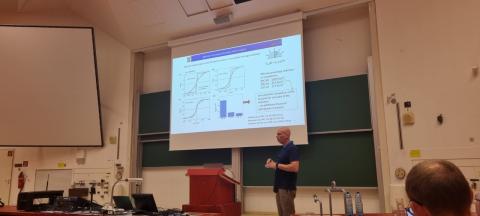
Dr. Juliano Denardin, a CEDENNA researcher and faculty member of the Department of Physics at the University of Santiago, Chile, was the only Latin American scientist to deliver a presentation at the First International Symposium on Three-Dimensional Nanomagnetism, “3DMAG 2026,” held from July 13 to 17 in Vienna, Austria.
At the event, the researcher presented a study on how the curvature and geometry of nanoscale structures can modify their magnetic behavior and open new possibilities for data storage, sensor development, and future computing technologies.
3DMAG 2026 was the first edition of this international symposium devoted exclusively to three-dimensional nanomagnetism. The event brought together specialists in nanofabrication, magnetic characterization, theoretical modeling, spin topology, magnetization dynamics, spintronics, and magnetic nanodevices.
Dr. Denardin valued the opportunity to participate in an event that brought together researchers from different countries. “It was an excellent opportunity to listen to leading scientists in nanomagnetism and spintronics, visit state-of-the-art laboratories, such as those of the 3DNANO group, engage with other researchers, and discuss potential international collaborations,” he said.
Geometry to control magnetic structures
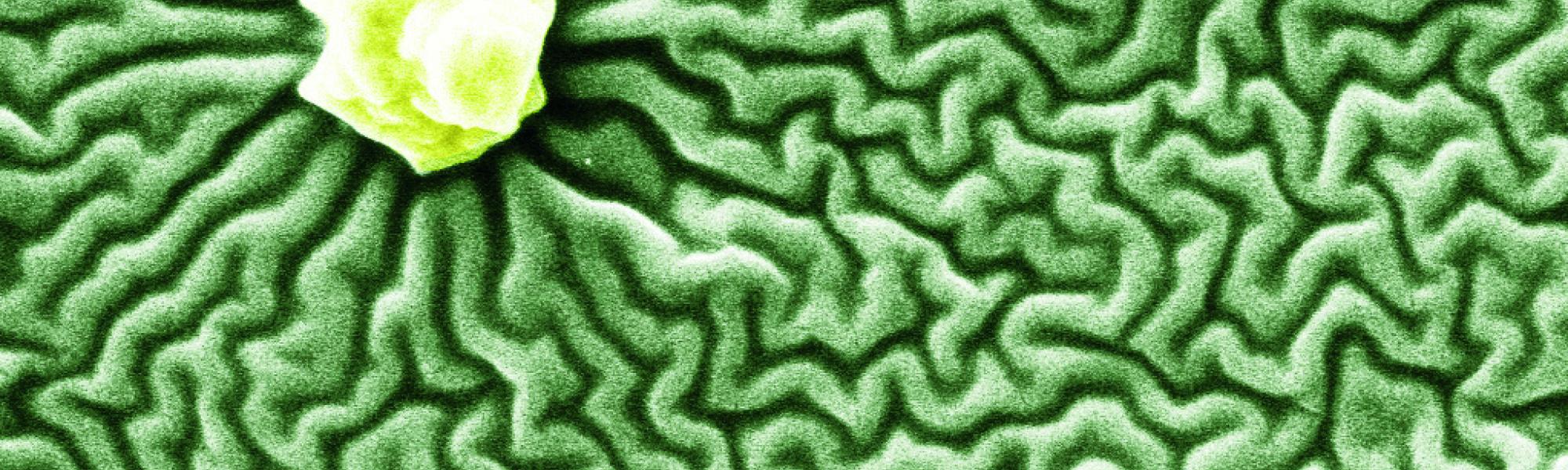
The CEDENNA researcher presented the study “Geometry-Stabilized Skyrmions and FORC Hall Analysis in Curved Pt/Co/Ta Nanodomes,” which focuses on the behavior of magnetic structures known as skyrmions on curved surfaces formed by nanodomes coated with layers of platinum, cobalt, and tantalum.
This area of research examines how incorporating new geometries and topologies into nanoscale structures can produce physical behaviors that are not observed in flat or two-dimensional systems.
The study is part of the search for new ways to control extremely small magnetic structures through geometric design. Skyrmions are stable configurations of the magnetic moments within a material and are being studied for their potential use as information units in future data storage and processing devices.
Research in three-dimensional nanomagnetism could contribute to the future development of information storage technologies, sensors, spintronic devices, unconventional computing, and biomagnetism-related applications.
- Log in to post comments