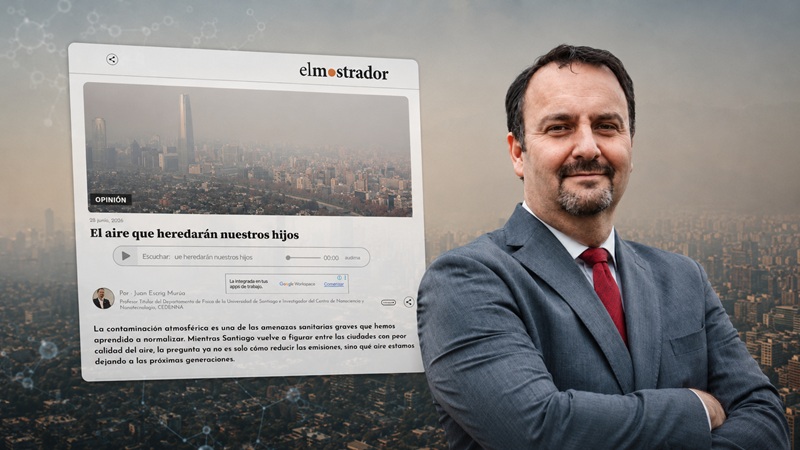

Air pollution has become one of the serious health threats that society has learned to normalize, despite its effects on the health and quality of life of millions of people. This was stated by Dr. Juan Escrig Murúa, full professor in the Department of Physics at the University of Santiago and researcher at the Center for Nanoscience and Nanotechnology, CEDENNA, in an opinion column published by El Mostrador.
In the text, titled “The Air Our Children Will Inherit”, the academic reflects on the recent critical pollution episodes in Santiago and raises a question that, in his view, should have a more permanent place in public debate: what kind of air future generations will inherit.
“This question does not arise from alarmism. It arises from scientific evidence,” the researcher says, warning that air pollution usually enters public discussion only for a few days, especially when environmental alerts or pre-emergency warnings are declared, only to then be displaced by other urgent issues.
From a scientific perspective, Dr. Escrig explains that an important part of the problem is linked to scale. PM2.5 particles, which are monitored during critical pollution episodes, are about forty times smaller than the diameter of a human hair. Many of the most harmful particles can reach nanometric dimensions, allowing them to pass through the body’s natural defenses, reach the lungs, and even enter the bloodstream.
“Air pollution is, to a large extent, a matter of scale. The most harmful particles are invisible to our eyes, but their effects are profoundly real,” he writes in the column.
In this context, the CEDENNA researcher argues that understanding how these particles move through the atmosphere, how they interact with the body, and how to reduce their impact requires sustained scientific research, technological development, and the training of specialized capacities.
He also highlights that some of the most promising solutions arise precisely at the nanoscale. Nanotechnology makes it possible to develop more precise sensors to monitor pollutants, materials capable of capturing harmful particles, and new energy technologies that could help reduce emissions.
For CEDENNA, this type of reflection reinforces the importance of research in nanoscience and nanotechnology applied to the country’s challenges, especially in areas such as the environment, health, energy, and the development of advanced materials.
Dr. Escrig stresses that improvements in air quality do not happen by chance, but are the result of scientific knowledge, public policy, technological innovation, and collective decisions sustained over time.
“The most important legacy we leave to our children is not only the city we build, but also the air we allow them to breathe,” the academic concludes.
You can access the full column HERE.